

On November 7, 2023, the US Geological Survey issued a press release announcing that it would invest US$2 million of Bipartisan funding with 14 states to study the potential for critical mineral resources in mine waste. The aim is to map locations of mine waste (i.e., tailings) and measure the potential for critical minerals that might exist there.
Cool. I thought. I’ve got lots of tailings practitioners in my network. I’ll share it on Linkedin. I posted the story and went about my business for the day.
When I logged in the next morning, I was surprised (and a bit delighted, I won’t lie) to see that the post had received over 25,000 impressions. Clearly tailings professionals aren’t the only ones interested in the fate of mineral residues these days.
For a few years now, tailings management and reprocessing have been some of the most searched topics on The Intelligent Miner.
The Global Tailings Review, which was convened in the wake of the 2019 Brumadinho tailings dam collapse in Brazil, and the resulting Global Industry Standard on Tailings Management (GISTM), have had a transformative effect on the way in which the mining industry and its stakeholders view and treat tailings.
They have elevated the issue of tailings storage, management and governance to the board level and beyond, and have contributed significantly to the level of attention these matters receive from the general public.
But demand for responsible mining practices isn’t the only trend driving interest in tailings today.
Combatting critical mineral shortages
The International Energy Agency’s Critical Minerals Market Review, which was published in July 2023, revealed that electric vehicle (EV) sales increased by 60% in 2022, exceeding 10 million units.
Energy storage systems experienced more rapid growth, with capacity additions doubling in 2022. Solar PV installations continue to grow in number, and the IEA expects that wind power will resume its upward march after two subdued years.
This activity has led to a big increase in demand for critical minerals and metals. From 2017 to 2022, demand from the energy sector was the main factor behind a tripling in overall demand for lithium, a 70% jump in demand for cobalt and a 40% rise in demand for nickel.
Driven by increasing demand and high prices, the market size of key energy transition minerals (as defined by the IEA) has doubled over the past five years, reaching US$320 billion in 2022. As a result, energy transition minerals, which used to be a small segment of the mining and metals market, are now center stage.
However, there are projected supply-demand issues. Research from McKinsey & Co has found that “even with the current decarbonisation trajectory trending toward 2.4° Celsius, the supply of many minerals and metals embedded in key lower-carbon technologies will face a shortage by 2030”.
It states that, while some materials, such as nickel, may experience modest shortages (approximately 10-20%), others such as dysprosium, which is used in electric motors, could see shortages of up to 70% of demand.
Copper is the hard hitter. This metal is used, not only in almost every low-carbon energy technology, but also in EVs, power transmission infrastructure, communications technologies… all sorts.
Research firm, S&P Global, expects demand for copper to double to 50 million tonnes per year (Mt/y) by 2035. “Assuming mining output continues to grow at a rate of 2.69% annually (as it has done for the past decade), global output will reach a mere 31 Mt [by 2035],” it states.
That’s a shortfall of nearly 20 Mt/y.
Given these projections, it’s easy to see why, today, ensuring access to critical mineral and metal supplies is, for many countries, a matter of national security.
Tailings as a source of minerals and metals
But what’s this got to do with tailings?
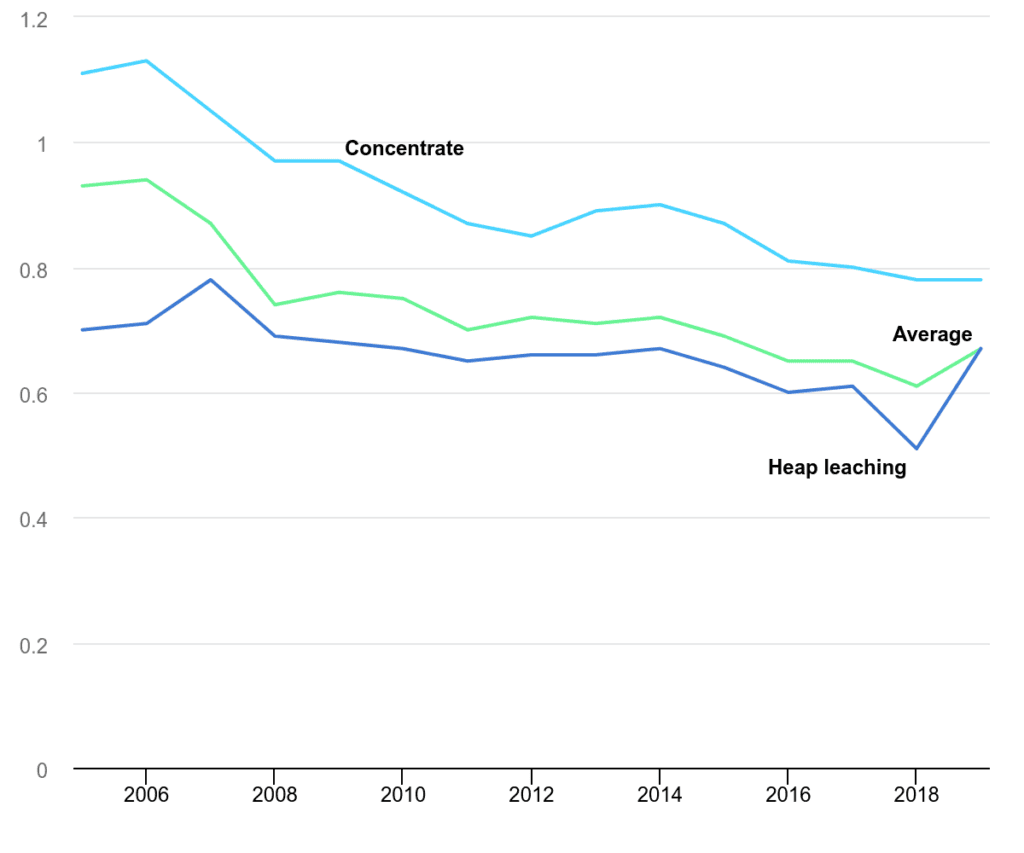
Well, put simply, the production of more metals will generate a lot more waste. For example, according to the IEA, the average copper ore grade in Chile – the world’s largest copper producer – in 2019, was 0.7% (see figure 1). That means that, for every tonne of ore mined, 99.3% of the material moved goes to waste.
The realisation that tailings can, in some cases, contain higher grades of residual metals than virgin deposits and, that much of the leg work required to liberate them has already been done, has sparked multiple studies to assess the volume of supply that might be possible.
The USGS project mentioned earlier is one example. In Australia, Geoscience Australia, the Royal Melbourne Institute of Technology (RMIT) and the University of Queensland launched an Atlas of Australian Mine Waste in 2023.
This maps sites across the country that could contain previously overlooked critical minerals, and there were over 1,000 sites on the database by June 2023.
Madeleine King, Minister for Resources and Northern Australia, commented in the media release: “Some of the minerals we need now, and into the future, may not just be in the ground – they’re also in rock piles and tailings on mine sites around the country.
“These minerals might not have been of interest when first extracted but could now be in hot demand as the world seeks to decarbonise – for example, cobalt in the tailings of old copper mines.”
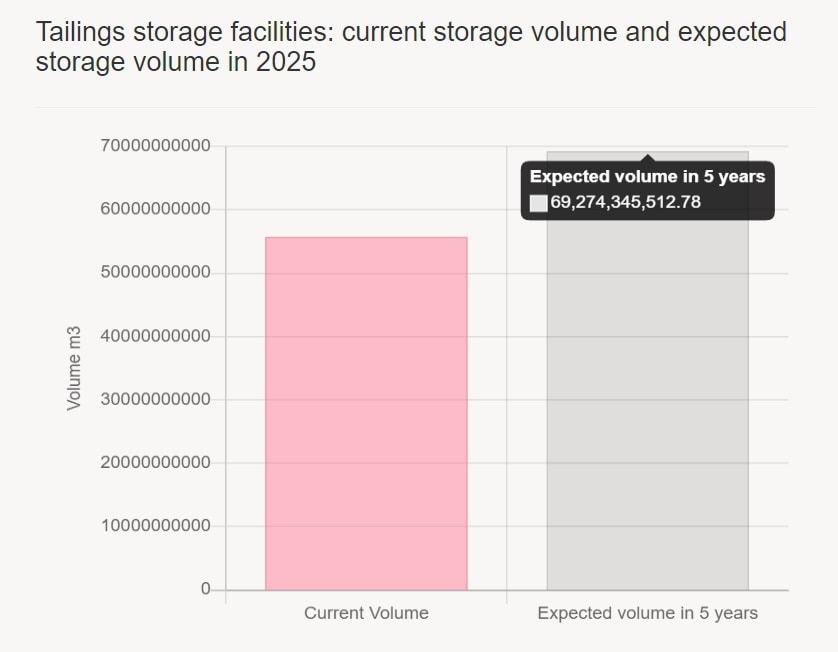
The Global Tailings Portal – a free, searchable database with detailed information on more than 1,800 mine tailings storage facilities (TSFs) around the world – was launched in January 2020. According to the portal’s overview page, the current storage volume of the facilities on the database stands at 56 trillion cubic metres of tailings. By 2025, this is expected to rise to nearly 70 trillion cubic metres (see figure 2).
While storage capacity will always exceed the actual volume of tailings produced (it’s the industry’s responsibility to anticipate and prepare ahead to safely store its waste), and not all tailings will contain valuable minerals, if you want to get a feel for the scale of the opportunity, it’s a solid place to start.
What does tailings reprocessing involve?
While remining and reprocessing tailings might seem like a new and exciting prospect, in reality, there are companies that have been doing this for years.
For example, PAN African Resources’ Elikhulu Tailings Retreatment Plant began operation in 2018 (the company also operates the Barberton Retreatment Plant).
Elikhulu exploits the 200 Mt of gold tailings accumulated over 70 years of mining at the Evander Gold Mining Operation. The retreatment plant can produce up to 65 000 oz of gold per year (oz/y), and it has mineral reserves of 1.5 million ounces (Moz) of gold.
“Easily accessible, and with much-reduced production risks and labour requirements, tailings retreatment is attracting greater investor interest due to the inherently safer nature of surface operations and also due to the very attractive economic returns of these operations,” CEO, Cobus Loots, wrote in this 2020 article.
“However, tailings retreatment is not without its own set of economic hurdles and pitfalls. Given the technical complexity and the significant capital investments required in the construction of tailings retreatment plants and depositing facilities, economies of scale are generally key. Normally, bigger is better, so to speak.”
Before tailings can be retreated or reprocessed, they must first be removed from the TSF in which they reside.
This can be tricky because, while consolidation, compaction and dehydration naturally occur over time, ‘wet’ tailings (which are a mixture of fine grained mineral waste and water, placed in the TSF as a slurry and held in place with a dam) usually contain a high percentage of water (~20-45% by weight).
This means they can these be prone to liquefaction long after placement which can restrict the use of heavy machinery. In many cases, it’s safer and more cost effective to turn the tailings back into a slurry and pump it back to the mineral processing plant for treatment or create a new dedicated plant nearby.
Royal IHC has developed a Tailings Slurrification Unit specifically for this purpose. In this article, Stefan Groenheide, Mining consultant at IHC Mining, explains another method too: “One of the first locations to use alternative recovery methods was in South Africa, to process gold tailings,” he says.
“The country is home to numerous dry gold tailings heaps that are re-mined using water jets, or hydraulic mining monitors (inspired by operations in England’s Cornish Kaolin mines).
“The monitor uses high-pressure water to erode the tailings from the dry heaps, washing the material downstream where it is collected in a reservoir. Here, the material is pumped to a processing plant to extract the gold.
“This operation is much more cost-effective compared to a truck and shovel operation, due to the use of slurry transport. However, the majority of the tailings are stored together with process water, which makes hydraulic monitoring of dry heaps impossible.”
A proven source of value
In this e-book, mineral processing OEM, Metso, explains that reprocessing involves removing tailings from an existing dam or paste TSF via dredging or excavation, mixing them with water and pumping them to a reprocessing plant.
“Depending on how coarse the particles are, some regrinding, milling and screening may be required prior to beneficiation to liberate the valuable minerals from the gangue,” the company states. “The leftover tailings are then dewatered and, depending on the preferred storage method, the resulting material is pumped to a paste plant or TSF, or conveyed and stacked in a dry TSF.”
According to Metso, the benefits of reprocessing are three-fold: first, removing water from tailings (new or legacy) gives greater control over where and how they are stored, opening the possibility for methods such as dry stacking, use in the creation of final landforms, or as a backfill material to stabilise underground voids left by mining.
Second, it allows valuable water to be recovered, and for the risks associated with storing wet tailings to be reduced. And third, valuable metals that were, in the past, difficult to liberate can often be recovered with newer, more efficient technologies.
I would add a fourth benefit: reprocessing also allows sand, mica and other useful minerals to be recovered and, potentially, sold to create new product streams. This would lower ultimate storage requirements and generate income, which could help to offset processing costs and make operations more circular.
For example, in November 2023, Vale launched a company called Agera to develop and expand its Sustainable Sand business. Based in the state of Minas Gerais, Brazil, Agera receives the sand produced from the treatment of tailings at Vale’s iron-ore operations in the state and promotes its commercialisation and distribution.
Vale began producing Sustainable Sand in 2021 after seven years of research as a substitute for sand extracted from the environment. Since then, around 900,000 t of the product have been sent to the construction sector and road paving projects. The expectation is to sell 2.1 Mt in 2024.
Fabiano Carvalho Filho, Vale’s Business Development Director, explained: “We created Agera with the aim of scaling a business that is helping us to reduce the use of [tailings] dams and piles in Minas Gerais, as well as helping to replace natural sand, which is often extracted predatorily from riverbeds.
“The creation of Agera is strongly linked to our strategy of promoting circular mining, which means strengthening the concepts of the circular economy in mining, associating economic development with better use of natural resources.”
From minerals to metals
While reprocessing isn’t physically or economically feasible for every tailings operation, a large number of operators are investigating the possibility, or moving ahead with plans.
In February 2022, Barrick opened a Tailings Reprocessing Project at its Golden Sunlight Mine in Montana, US. Golden Sunlight produced more than 3 Moz of gold during its 40 years of operation. The mine shut down in 2019 when virgin gold production was no longer economically viable.
The facility now reprocesses gold tailings from the Golden Sunlight mills. The focus is on removing and concentrating sulphur (iron pyrite) to be sold to, and used in gold production, by Barrick-operated and majority owned Nevada Gold Mines – the largest gold producing complex in the world.
The concentrated sulphur is not only valuable, but its removal eliminates a source of potential groundwater contamination. After reprocessing, the remaining benign material is backfilled into the Mineral Hill pit.
Barrick said that the project has created more than 75 jobs and has the potential to generate tens of millions of dollars in tax revenue and benefits for the state over the next decade.
Codelco and Sibanye Stillwater are also reprocessing their tailings with high commodity grades to extract residual metals, including copper and platinum. And, in May 2023, Sibanye acquired New Century Resources whose innovative tailings recovery-based business model I covered in this Intelligent Miner article.
In November 2023, cleantech company, EnviroGold Global, completed initial test work for a nickel tailings project with a ‘major global mining company’. This focused on optimising nickel, copper, cobalt, and platinum group metals (PGM) recovery processes from nickel mine tailings.
The company said the results demonstrate “a step change in efficiency in extracting critical metals from these waste materials” and will allow it to move to second phase testing in Q1 2024, with work on pre-pilot plant testing contingent upon its success.

The Bluestone Mines Tasmania Joint Venture (BMTJV) is currently updating studies at the tailings retreatment project (Rentails) at the Renison tin operation in Tasmania. The intention is to finalise a definitive feasibility study and environmental permit within the next two to three years to facilitate an investment decision by BMTJV.
Existing TSFs at the operation contain 23.2 Mt of tailings with significant amounts of both tin and copper. Metals X, which owns a 50% equity interest in Renison though its 50% stake in BMTJV, expects to make permitting applications for the construction of a “new high-technology tailings reprocessing plant with a capacity of approximately 2.5 Mt/y, a modern TSF and supporting infrastructure”.
It said the project would minimise wastage and maximise re-use of existing valuable resources by extracting value from the tailings left over from previous mining and processing.
Building a UK-based EV battery supply chain
Meanwhile, UK-based cleantech group, Altilium, has secured UK government innovation funding for two collaborative research projects focused on the recovery of copper and rare earth elements (REE) from mine tailings.
The company is partnering with CPI and Camborne School of Mines (CSM) for these. Altilium has exclusive rights to reprocess materials from the largest mine tailing site in Eastern Europe, and analysis has confirmed significant residues of copper, iron, aluminium and other metals.
Hydrometallurgical processing of the tailings will be carried out at a new solvent extraction pilot plant at Altilium’s Technology Centre in Tavistock, UK. This work will focus on developing leaching techniques and efficient separation methods, while minimising waste generation and environmental impact.
The 12-month ReTail project, in partnership with CPI, aims to establish the feasibility and environmental impact of processing tailings from Altilium’s site in Europe to extract copper, aluminium and other battery materials for use in the UK EV battery supply chain (for example, to produce copper foils for use as current collectors).
With CSM, Altilium is working on a feasibility study to recover REEs from mine tailings using hydrometallurgical processes. As well as evaluating the technical and economic viability of the process, the study will include an environmental impact assessment to ensure sustainable practices and minimise ecological footprint.
Geochemical and mineralogical characterisation of tailings will be carried out by CSM, while Pensana Plc will provide commercial feedback on the recovered materials.
Moving from a waste to value mindset
These are just a handful of the many projects underway across the globe to assess and access the minerals and metals contained within mine tailings, including those that are vital to the energy transition.
They clearly illustrate the value that industrial ‘wastes’ can hold if we care to look at little harder at their constituent components. And how, with a little imagination and the application of circular principles, these materials can make an important contribution towards meeting future supply needs.
2 comments
Adam Greetham
Tailings are the next generational opportunity, benefiting from past energy spent, and our future energy storage.
Achint Goel
Very good article future time is exploit tailings and there is great advantage no need of mining and size reduction.