

Geopolitical disruptions are affecting supply chains and the geographic demand for minerals. The emphasis on ‘critical minerals’ to support electrification and climate change mitigation, as well for defence, continues to grow.
The G7 has a critical minerals strategy that emphasises responsible sourcing and, concurrently, legislative changes in Canada (at the federal level, and in British Columbia and Ontario at the provincial level) are intended to speed up major projects, including mining projects such as those in Ontario’s Ring of Fire.
These changes are creating uncertainty and raising concerns in both Indigenous Nations and communities and non-Indigenous communities in Canada.


The mining industry is in the early stages of operationalising the UN Declaration on the Rights of Indigenous Peoples (despite it being nearly 20 years old) and the associated principles of Free, Prior, and Informed Consent.
Pressure from the public, investors, communities, and Indigenous Peoples is nothing new, but today it feels more acute: stakeholders are looking for much more say in how and if projects proceed.
To respond to these challenges, to thrive in an era where there is no easy mining left, the industry needs to do things differently. But how?
Complexity in the context of mining projects
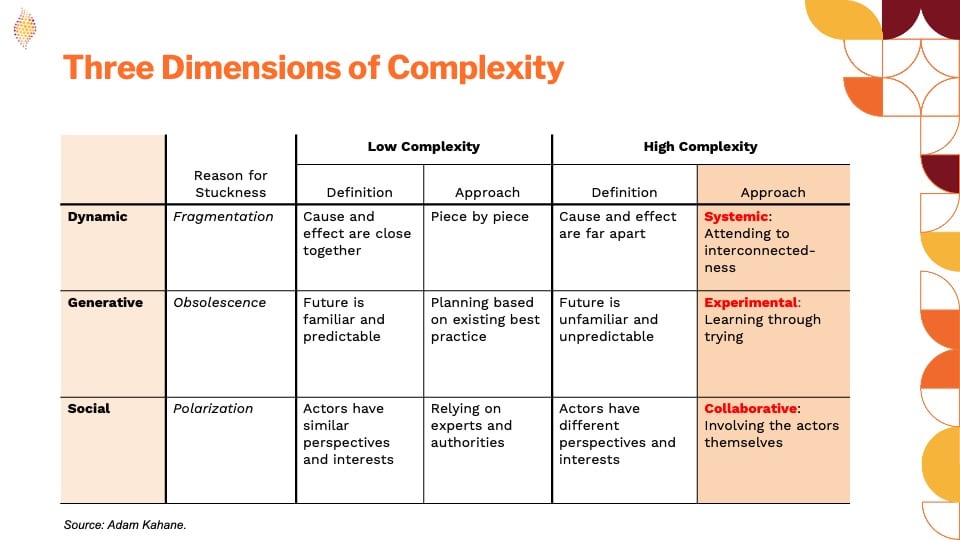
First, the complexity of mining projects must be acknowledged, especially the multi-faceted nature of that complexity:
- They’re socially complex because project stakeholders have divergent perspectives, interests, and needs that can’t be resolved unilaterally. In contemporary regulatory regimes and social environments, there are few places where mines can be developed or even continue to operate without some level of community support and benefit.
- They’re dynamically complex, because cause and effect are separated in space and time. We excavate an open pit and might affect groundwater several kilometers away. We choose a location for a tailings facility in a scoping study and uncover its cultural significance five years later when the environmental assessment is performed.
- They’re generatively complex, because standard approaches to project development are no longer applicable given the rapid confluence of larger contextual challenges facing the industry. While there are examples of new, more applicable approaches, they aren’t yet accepted as standard practice.
Responding to complexity through stakeholder-integrated project stewardship
Conventional approaches to engagement that often focused on informing and consulting rather than deeper levels of engagement, are insufficient for addressing the social complexity of contemporary mining projects.
Consequently, they’re also inadequate for meaningfully working through the multitude of questions, options, and decisions a mining project faces.
Acknowledging the complex nature of mining projects allows the use of responses suited to navigating that complexity. Particularly crucial in today’s context are more effective ways to work with social complexity by integrating all stakeholders in project stewardship.
Successfully working with complexity requires a range of responses. For example:
- Collaborative approaches, as a response to social complexity, create the conditions for diverse stakeholders to meaningfully contribute to how a project unfolds. For example, this requires a shift from community meetings with information boards to collaboratively generating and assessing potential mine layouts through integration of local knowledge.
- Systemic approaches, as a response to dynamic complexity, create the conditions to think about a potential mine within its larger context, and how it’s both affected by and affects this larger context. For example, stakeholders can collectively use expert-generated projections of how climate change may affect the regional water supply to develop regional water management plans, acknowledging a mining operation as one of many water users.
- Creative approaches, as a response to generative complexity, support stakeholders and project proponents in fostering something new. For example, mine closure is typically approached as “putting things back to the way they were”, but different land uses after mining that might generate revenue for the community (e.g. renewable energy generation) might be attractive to stakeholders.
For these approaches to be effective, two mindsets are essential:
1. Focus on relationships at least as much as on outcomes. There’s a strong emphasis on outcomes in the industry: getting permits, shipping the first concentrate, or pouring the first bar of gold. But trusting stakeholder relationships is as essential to a project as an environmental assessment certificate.
2. Wherever possible, let stakeholders lead project development processes. Traditionally, communication and relationship processes are tightly controlled by mining companies. But letting stakeholders choose and lead communication processes can generate new ideas. Exploring closure land use decisions is a space where community or Indigenous-led engagement may be fruitful.
Acting and thinking in these ways is the beginning of a shift from traditional engagement to stakeholder-integrated project stewardship, where all stakeholders are core to planning, decision-making, and if agreed, project execution.

The result is de-risking projects
Stakeholder-integrated project stewardship has the potential to be a value-add approach in the mining industry, contributing to:
Lasting partnerships: The timeline between orebody discovery and operating mine can be decades long. Relationships take time, so the earlier relationships with stakeholders are put at the centre of projects, the more likely they are to be successful and the more they can contribute to innovative project design. A strong ecosystem of community and regulatory involvement can set the standard for a project that might last decades, adding value as the project progresses.
Shared ownership: People believe in and will contribute to what they co-create. A project will be more successful if stakeholders and rights holders have ownership (emotional and perhaps legal) than if the proponent has simply gotten ‘buy-in’.
Creation of better data: Stronger relationships mean that the project and its context are better understood by the participants. Local and Indigenous knowledge can provide ideas and input that more typical approaches might miss, resulting in efficiencies from projects that are better suited to the local environment.
Enhanced reputation: A track record of trust, transparency, and incorporation of stakeholder input can make dealing with change on existing projects easier. Also, success on one project sets up success on another.
In taking these approaches, many challenges are addressed simultaneously. We’ll have more reliable and greater access to critical minerals. Projects will be more robust and resilient relative to environmental and social considerations.
Effective partnership with Indigenous communities is part of reconciliation and can uphold and reinforce Indigenous rights. Local and Indigenous communities can experience economic development on their terms and to their benefit, including benefits that may extend past the life of mine.
To learn more and continue the conversation, connect with Brenna and Kathleen on Linkedin.