

Downstream companies across the mining and metals value chain, ranging from utilities to automotive OEMs and their respective supply bases (including transformer and battery manufacturers), are heading directly into a supply chain crisis.

Electricity networks are highly dependent on minerals like copper, nickel, aluminum, and rare earth elements (REEs). Technologies like electric vehicles (EVs), battery storage, and renewables require 5-10x more minerals per unit of energy than fossil fuel systems.
The auto industry and other manufacturers rely on REEs, of which China controls nearly 70% of mining, 85% of refining capacity, and 90% of rare-earths metal alloy and magnet production. The growth of AI and data centres and the energy expansion the world is in the midst of is exacerbating things further.
China has played the long game with minerals, using strategic investments to control different parts of the supply chain on a mineral-specific basis, and as a result, currently dominates many mineral markets.
It has a different choke point on the supply chain of each key mineral, and we’ve seen it leverage that control in various ways.
For example, though copper is mined globally, more than half of its concentrate is refined in China. The country has rapidly expanded its processing capacity, giving it the ability to take zero conversion fees for smelting and thus crushing margins.
In the case of nickel, China’s investment of over US$20 billion into Indonesia, which has risen to the world’s largest nickel producer, means that China controls 55% of the nickel concentrate globally.
Last year it flooded nickel markets, suppressing prices and resulting in the collapse of the New Caledonian and Australian nickel mining sector. We’ve seen similar market-shaping activities with lithium as well, and there’s major concern around REEs.
Understanding the headwinds
Auto companies should be terrified about a potential bottleneck when it comes to REEs, which China also controls. Despite the supply shock the industry faced during the semiconductor shortage in 2021, many companies have not properly strengthened their supply chain strategies and are even more vulnerable today.
China’s market dominance in minerals is just one of the major headwinds causing the minerals famine, none of which are well understood by downstream companies and are an important wake-up call.
In addition to this state-directed market shaping and ongoing supply shocks, the mining and metals industry must contend with resource nationalism, where resource-rich nations are exerting more control over mining activities and related profits in an effort to retain more a resource’s downstream value.
An Indigenous reframe is also underway, in which communities are engaged as owners rather than stakeholders, moving from consultation to true prosperity beyond the life of the mine.
While the indigenous reframe is a positive change in its effect on society as a whole, this shift and the accompanying evolution from a purely ‘extract and ship’ model can affect resource development and extraction timelines even further.
Technical supply challenges are by far one of the greatest issues for the industry and desperately calls for collaboration and joint investment between upstream, midstream, and downstream companies.

In the case of copper, demand outpaces supply even in optimistic scenarios. As of 2024, global copper production was estimated at 23 million tonnes per annum. However, it must expand to meet demand – best estimates of supply show a 20-30% deficit by 2035.
For utilities and electric vehicle manufacturers especially, this critical mineral in power generation, transmission, and electrification will almost definitely see escalating costs in response to the significant supply-demand gap.
We must work together
The deeper we mine, the more resource-intensive it becomes to extract something of value. Major copper projects used to take 3-4 years to complete; we’re now looking at a 20-year time horizon to move mining projects from discovery to first production.
The mining industry has persistently under invested in innovation, and the challenge of responsibly extracting and processing minerals with these increasing technical and geological hurdles (e.g., declining ore grades), and doing so amidst a high-regulation environment, has resulted in a high-cost, slow-moving mining industry.
The industry must ramp up innovation efforts, and that demands partnership and investment from the downstream companies it supplies. The industry can’t do it alone, and ultimately, it’s consumer companies that will suffer if swift action is not taken.
Mining companies need to become materials companies, mid- and downstream companies need to help speed up the development cycle, and governments need to amend permitting policies. At its core, this requires a cultural change that regularly encourages this type of up-and-down-the-value chain dialogue and collaboration.
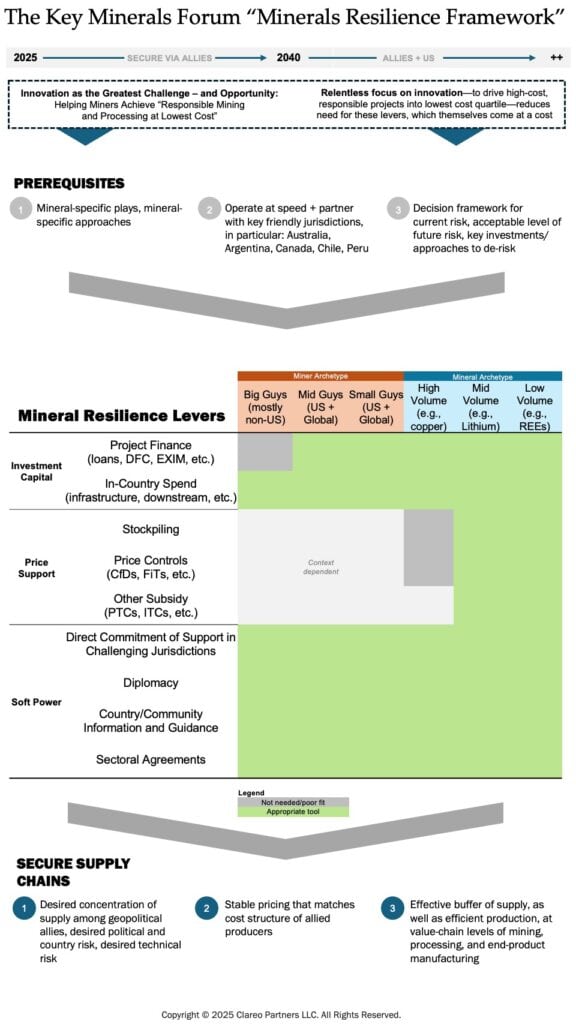
The Key Minerals Forum, in its recently launched Copper & Lithium Roadmaps, and shared a Minerals Resilience Framework (see below), which provides a map for public/private collaboration and guideposts for developing a strategic approach to do so, given current constraints.
No time to waste
This is an urgent call to action. As the world undergoes this energy expansion, neither downstream nor midstream companies are adequately addressing these risks, ramping up the urgency even further.
The clock is ticking. It should be an urgent priority for downstream companies to develop worst-case scenarios, unpacking the risks, implications, and actions they must prioritise to mitigate those risks, be it via adjustments to investments, public policy, innovation, and more cross-sector and supplier collaboration.
Continue the conversation: Peter Bryant is the board chair of Clareo, an international strategy consulting firm focused on natural resources, energy, and food industries. He is also the board chair of the Development Partner Institute.