

When The Electric Mine event was first conceived in 2018 (the inaugural event was held in Toronto in 2019), there was nothing quite like it in the mining industry. Electrification was still a niche topic, discussed in pockets across OEM presentations and underground mining forums, but there was no dedicated platform bringing together miners, suppliers and technology developers to focus specifically on what an electrified mining future might look like.
Battery-electric vehicles (BEVs) quickly became the poster-child technology of that transition and, for a time, much of the industry’s attention centred on BEVs. Could they handle underground conditions? Would batteries be safe? Could electric fleets ever match diesel productivity?
Yet, according to Daniel Gleeson, Managing Director at IM Events, even in those early years, the conversation at The Electric Mine was always broader than battery-powered equipment.
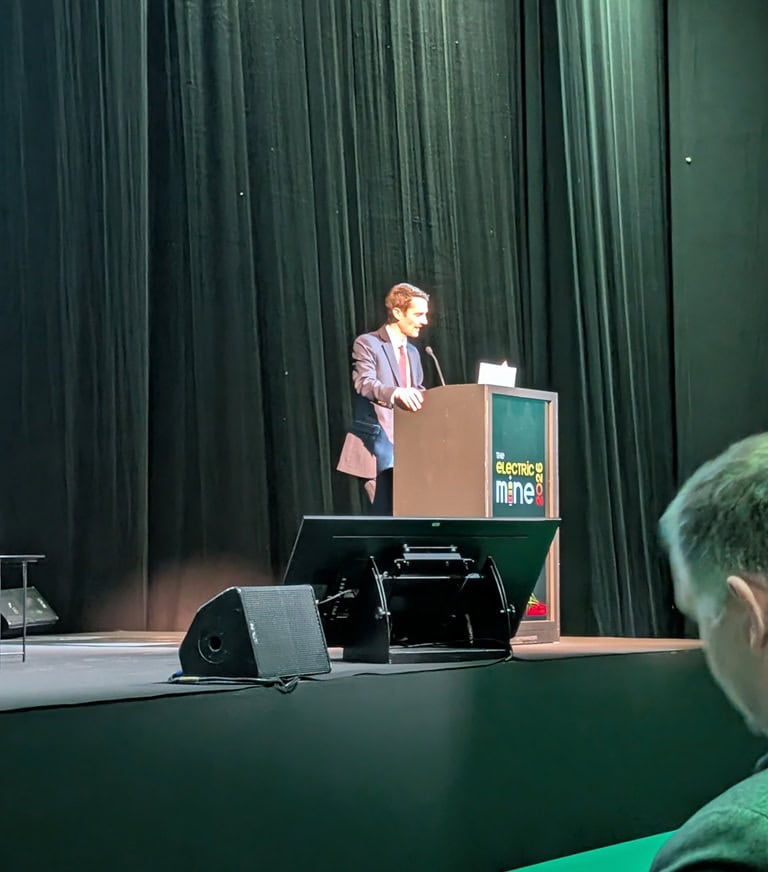
Daniel Gleeson, Managing Director of IM Events, welcomes delegates to The Electric Mine 2026. Image: Carly Leonida
Electrification, by its very nature, touches almost every part of a mining operation, including ventilation, energy infrastructure, mine design, charging strategy, automation, maintenance, workforce training and operational planning. That wider systems-level thinking was on full display at this year’s event in Lisbon, Portugal.
The Electric Mine 2026 felt less like a technology showcase and more like an industry working through the practicalities of integration. Held over four days, the event brought together miners, OEMs, technology developers, energy specialists and infrastructure providers to examine the realities of mine electrification from both underground and surface perspectives.
The agenda reflected the industry’s growing maturity with sessions ranging from autonomous BEV loaders and dynamic charging systems to charging interoperability, energy management and mine-wide digital infrastructure.
The breadth of those discussions highlighted something important: electrification is increasingly being treated not as a standalone equipment decision, but as a systems challenge capable of reshaping the entire mine.
Electrification moves beyond proof of concept
That shift was evident throughout the conference. Miners presenting in Lisbon weren’t discussing pilot vehicles in isolated trial environments. Instead, they were talking about ventilation bottlenecks, charging strategies, battery swap logistics, productivity metrics and operational redesign.
At Eldorado Gold’s Lamaque Complex in Québec, for example, battery-electric equipment is no longer viewed primarily as a decarbonisation initiative. Instead, it has become a practical solution to a mine-planning challenge.
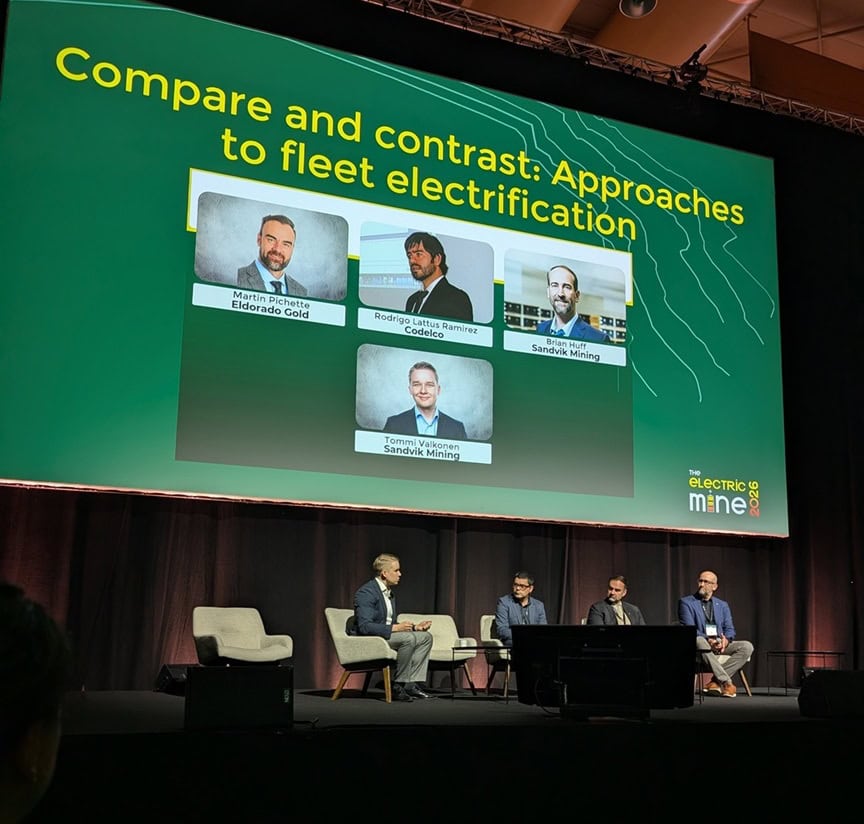
Speaking during the underground mining stream, Eldorado Gold’s Martin Pichette explained that the company’s electrification strategy was driven initially by the realities of deeper mining. As haul distances increase and mines extend further underground, ventilation infrastructure becomes increasingly difficult and expensive to expand.
“We moved to BEVs because of the economics at first, and also because of the environment,” Pichette told delegates. “Without the right economics, I’m not sure that mines will go all the way.”
That comment captured one of the dominant undercurrents running through the event. While decarbonisation remains a major driver for mining electrification, miners are increasingly evaluating BEVs through the lens of productivity, ventilation savings and long-term operating costs rather than environmental, social and governance (ESG) commitments alone.
At Lamaque, Eldorado is deploying Sandvik battery-electric haul trucks and loaders supported by underground battery swap infrastructure. By the end of this year, the operation expects to have 12 BEV units underground. According to Pichette, the electric haul trucks are already delivering significantly higher ramp speeds than comparable diesel units, translating into productivity gains of roughly 40% on uphill haul cycles.
That kind of performance reframes the electrification discussion entirely. A few years ago, the industry often approached BEVs as a compromise with cleaner, quieter machines that might eventually become commercially viable. Increasingly, however, electric equipment is being presented as the better operational tool for certain mining environments.
And operator acceptance appears to be following a similar trajectory. One of the recurring themes in Lisbon was that resistance to BEVs often fades quickly once operators begin using them. Reduced noise, lower vibration and improved air quality underground continue to emerge as significant advantages from a workforce perspective.
Pichette joked during his presentation that “operators are fighting to drive the truck”. While delivered lightly, the comment hinted at something deeper: workforce acceptance may no longer be one of the industry’s major barriers.
The systems challenge underground
If there was one idea repeated consistently throughout The Electric Mine 2026 conference stream, it was that electrification cannot simply be achieved by replacing diesel equipment with electric equivalents. Mines are discovering that successful electrification requires changes to infrastructure, planning, maintenance, ventilation, scheduling and energy management all at once.
Normet’s Mark Ryan illustrated this clearly during a presentation discussing the company’s work at Rio Tinto’s Oyu Tolgoi underground operation in Mongolia. Ryan described the site assessment process as “probably the biggest effort out of the whole process,” arguing that understanding infrastructure constraints and operational requirements early is essential if electrification projects are to succeed at scale.
At Oyu Tolgoi, Normet has helped deploy what it describes as the world’s largest integrated SmartDrive BEV fleet for underground logistics, charging and spraying applications. The operation now runs 65 machines supported by dedicated charging infrastructure and live equipment monitoring systems. According to Ryan, maintenance costs have been reduced by around 30% compared with diesel equivalents.
What stood out in Ryan’s presentation wasn’t just the scale of the deployment, but the emphasis placed on operational data. Battery-electric fleets generate vast amounts of information around charging behaviour, energy consumption, regenerative braking and equipment utilisation. Increasingly, miners are using that data to rethink how underground operations are managed.
Where electrification and automation converge
Throughout the conference, many speakers linked electrification with automation, remote operations and real-time fleet management. In some ways, the technologies are converging naturally (and IM Events plans to run a sister conference – The AI Mine – in 2027). Electric fleets rely heavily on digital infrastructure, wireless communications and advanced monitoring systems; many of the same foundations required for autonomous mining.
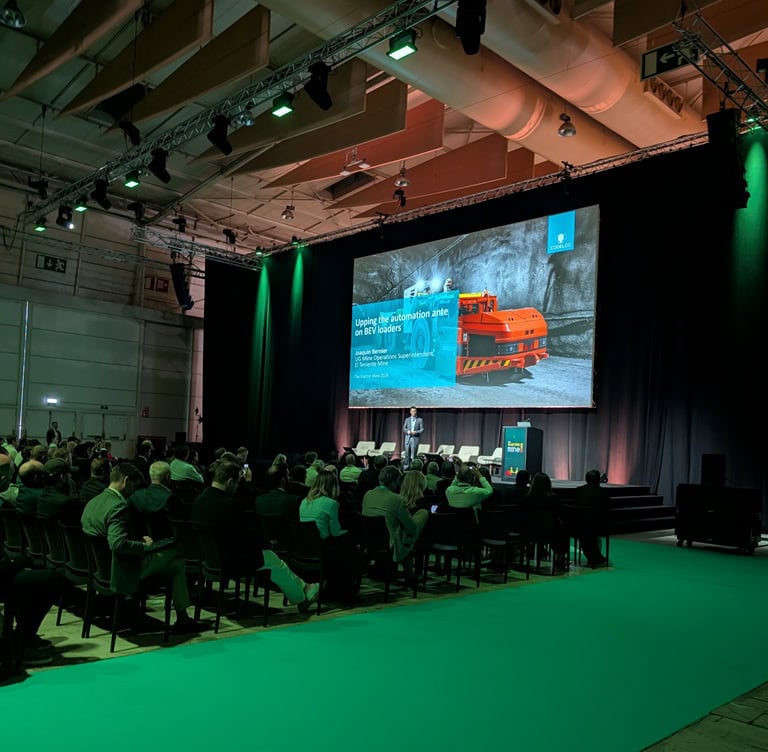
Chile’s El Teniente mine, operated by Codelco, provided one of the more advanced examples discussed in Lisbon. The mine has been trialling an autonomous battery-electric loader in a high-seismicity underground production environment as part of a broader effort to evaluate how automation and electrification can work together to improve both productivity and safety.
According to Joaquín Bernier, underground mine operations superintendent at El Teniente, the autonomous electric loader achieved availability levels comparable to, and in some cases better than, diesel equipment operating in the same production area.
That overlap between automation and electrification surfaced repeatedly during the event. Several speakers suggested miners deploying BEVs today should simultaneously be thinking about autonomous haulage, traffic management systems and integrated operational control centres.
In practice, many mining companies appear to be approaching electrification as part of a wider operational modernisation strategy rather than a standalone decarbonisation initiative.
Trolley systems return to the conversation
Another notable shift at this year’s event was the renewed attention being given to trolley-assisted haulage systems and dynamic charging technologies.
While earlier editions of The Electric Mine focused heavily on battery-electric equipment, this year’s conference featured extensive discussion around flexible charging concepts designed to reduce battery size requirements and improve haulage efficiency. Sessions involving ABB, BluVein, Caterpillar, Siemens and Epiroc all explored variations on dynamic charging and trolley-assisted systems for underground and surface mining applications.
The logic behind these systems is straightforward enough; as haul distances increase and trucks become larger, battery requirements grow substantially. Dynamic charging systems allow haul trucks to draw power while travelling on ramps, reducing battery cycling and potentially lowering total energy storage requirements.
Boliden’s Peter Wallin, one of the industry’s earliest advocates for mining electrification, reinforced the importance of maintaining flexibility as the industry navigates competing technology pathways. The message from both miners and OEMs was consistent: there’s unlikely to be a single electrification solution suitable for every operation.
That perspective increasingly appears to be shaping supplier strategies. Rather than pushing fully battery-electric fleets as the only future pathway, many OEMs are now discussing modular approaches involving diesel-electric systems, hybrid technologies, trolley infrastructure and progressive electrification.
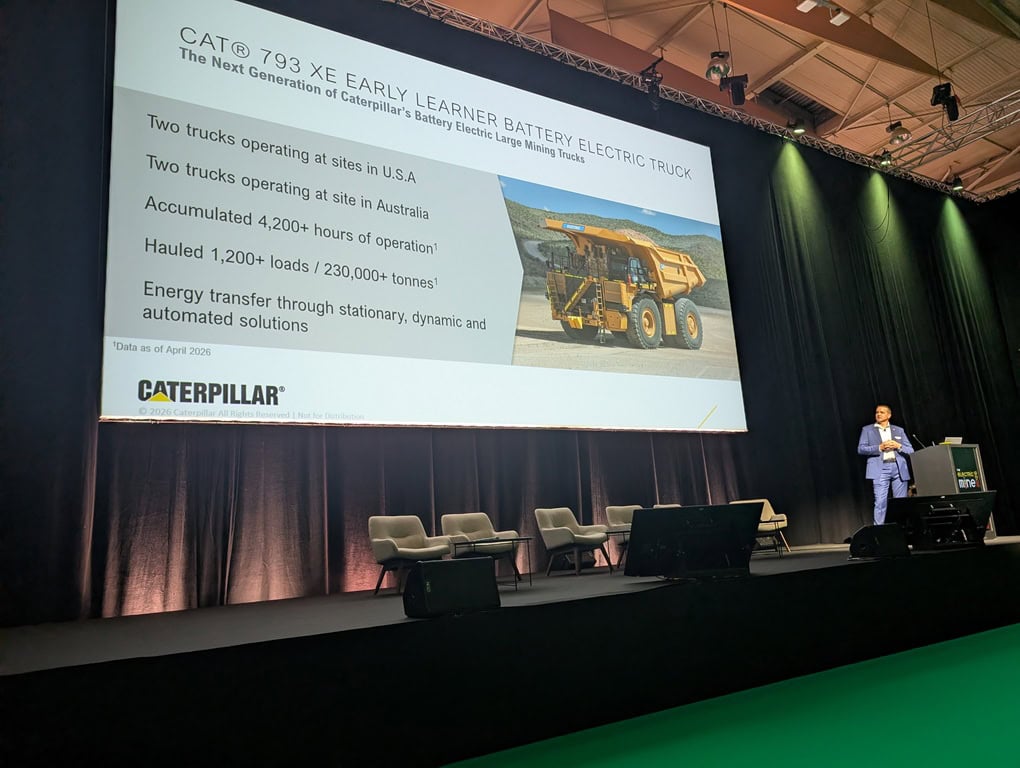
Caterpillar, for example, used the conference to outline how mining operations may transition gradually through diesel-electric and hybrid systems depending on infrastructure readiness, mine design and energy availability. Sandvik discussed similar thinking around diesel-electric concepts that could help familiarise mining workforces with electric drivetrains while reducing operational risk during the transition.
That growing pragmatism arguably reflects where the industry now sits in its electrification journey. The early hype surrounding BEVs has settled. Miners understand the technology better, and they also understand the complexity involved in deploying it.
Surface mining’s more difficult equation
Surface mining, in particular, continues to face a more difficult economic equation than underground operations when it comes to electrification.
Underground mines benefit from a powerful driver that open-pit operations generally lack: ventilation savings. Reducing diesel emissions underground can unlock substantial reductions in ventilation infrastructure and energy consumption, especially as mines deepen. Surface mines, by contrast, must justify electrification more heavily through productivity gains, fuel savings and energy efficiency.
That distinction was reflected clearly in the conference programme. While underground sessions focused heavily on operational deployment and scaling BEV fleets, the surface mining stream spent considerable time discussing hybrid systems, energy infrastructure, trolley-assisted haulage and charging optimisation.
Entering mining’s ‘messy middle’
Perhaps the clearest sign of the industry’s progress was the level of honesty visible throughout the event. Companies spoke openly about infrastructure constraints, difficult commissioning periods and operational setbacks. Early adopters acknowledged that some projects had struggled, but with recognition that those difficult experiences have accelerated industry learning.
The mining sector now appears to be entering a more commercially realistic phase of electrification defined less by ambitious future visions and more by practical operational integration.
There’s still uncertainty around which technologies will ultimately dominate. Some operations may move directly toward fully battery-electric fleets, while others may rely on trolley-assisted haulage or hybrid systems for decades. Many will likely operate combinations of technologies simultaneously. But the broader direction of travel now feels difficult to dispute.
The conversation has well and truly shifted from whether electrification works to how the industry can make it work well. And in mining, that may be the point where real transformation finally begins.
Read more about mine electrification here.