

“Some of mining’s most meaningful perspectives come from people who have never been asked to share them,” Michelle Hohn, founder of sustainability consultancy Akashic Communications and creator of GEMS told me.
This may seem like a simple observation, but it raises a question that reaches beyond storytelling and the individual: how much wisdom and insight is the mining industry leaving untapped because it hasn’t created the space for voices beyond the loudest or most senior ones to be heard?
Mining knows how to work with complexity. It’s skilled at interpreting data, signals and systems. However, the more subtle forces that shape culture, safety, retention and belonging are often carried in people’s lived experiences, where the personal and professional blend.
What might surface if companies, and individuals, became more curious about the perspectives that often remain hidden beneath the obvious? And what if those stories not only changed how women saw themselves, but also helped the industry understand itself more fully?
This is where GEMS Unearthed begins. Created by Hohn, the global storytelling initiative captures the experiences of women across mining and adjacent sectors as part of a living digital archive. Although GEMS purposefully integrates personal stories, those stories can open a wider view of mining itself, revealing lessons about culture, belonging, trust and the people shaping the industry’s future.

Unearthing what job titles leave out
Hohn has spent much of her career working at the intersection of communication, sustainability, and human rights due diligence, psychological health and safety, stakeholder engagement, counselling and expressive writing. Across those fields, one thread has remained constant: a deep interest in people and the conditions that allow their experiences to be heard.
“Every seemingly ordinary person has an extraordinary story,” she said, “but many meaningful stories go untold because nobody created the conditions for them to emerge.”
GEMS was created to change that. Through individual and group workshop-based story-building processes, it invites women to tell their stories from a deeper vantage point.
“What we’re unearthing or uncovering are the parts of ourselves and our journeys that are often hidden beneath job titles, achievements and day-to-day responsibilities,” Hohn explained.
The project is intentionally broad, inviting every woman, from the student just beginning, to the operator on site, the mentor, the executive assistant, the contractor, the consultant, the retiree and everyone in between.
Mining’s story is often told through scale, toughness and technology. Those aspects remain important, but they’re not the whole picture. The industry is shaped just as much through choices, doubts, relationships, turning points and the smaller acts of persistence that rarely fit into a corporate profile.
The power of being witnessed
Hohn has seen what happens when people are given permission to tell that fuller story, beyond resumes and LinkedIn profiles.
“During the story drafting process, GEMS authors universally recognise that the challenges, choices, doubts, values and relationships are not separate from their success,” she said. “They’re often the very things that created it.”
That recognition can be deeply personal, and yet there’s a special power that unfolds when it’s shared. In group workshops, one woman’s moment of clarity often gives another woman permission to look differently at her own experience. The “I’ve felt that too” moments create a deeper sense of connection because there is recognition, on a deeper level, in the similarities of lived human experience.
For many participants, the process is highly validating. Where professional environments often teach people to separate who they are from what they do, GEMS take a different and deliberate approach by treating their entire landscape of experiences as relevant.
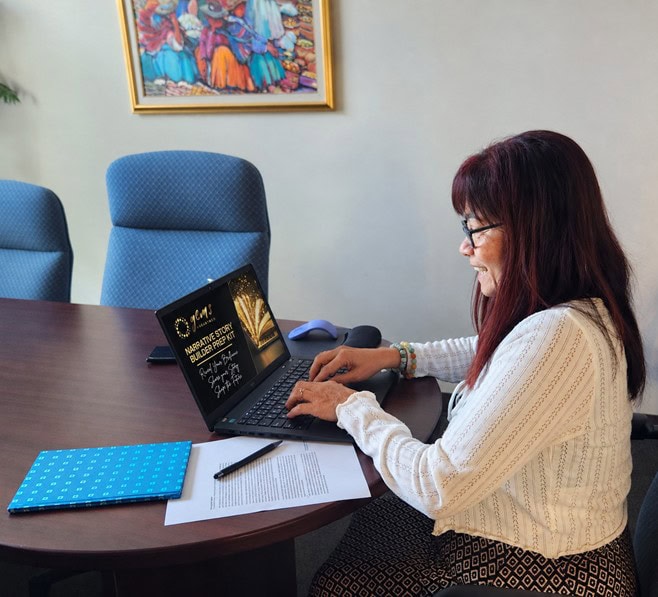
“Someone begins by thinking they’re sharing a series of ordinary events,” Hohn said, “but as they do so they start to connect dots and see patterns that they may never have acknowledged in themselves before.”
In an industry still working to improve inclusion, this is relevant beyond the personal level. Belonging can’t be created through campaigns, but it can be fostered through deliberate spaces for shared experience that allow us to recognise that there are many ways to contribute, lead and matter.
“Perhaps the bigger legacy,” Hohn said, “is supporting women, in any industry and at any stage of their careers, to recognise their own value without needing to compare it to someone else’s definition of success.”
What stories can show before numbers do
The value of storytelling doesn’t end with personal empowerment, though. Hohn also sees practical relevance for companies.
One area where an invitation to share personal experience can be highly valuable, Hohn knows, is occupational health and safety. “Many of the indicators traditionally reported tell us what has already happened because they measure incidents and injuries after they’ve happened,” she said. “But stories can help us understand what’s happening within a workforce before those outcomes occur.”
She went on to explain how layers within stories can reveal a great deal about safety culture; whether people feel able to stop work, raise a concern, admit a mistake, challenge a decision or ask for help. Stories can unveil whether trust, communication, psychological safety and accountability are actually present in day-to-day work.
“Numbers help us measure performance,” Hohn said. “Stories help us understand the conditions creating that performance. The possibilities relating to prevention are extremely powerful.”
It’s a research question she would like to see explored more formally, particularly the potential connection between storytelling, psychological safety and occupational health and safety outcomes.
Credibility beyond the report
Furthermore, Hohn has realised that storytelling also has a role in sustainability and social performance. Mining companies invest considerable effort in frameworks, policies, and reporting and performance disclosures and yet, she knows, credibility is not built by highlighting success alone.
“Credibility comes from honesty, transparency and acknowledging complexity,” Hohn reflected. “Facts help us understand what happened, but stories help us understand why it matters.”
This is particularly important in stakeholder engagement. A company’s understanding of its own performance is only one part of the story. To fully understand impacts, risks and opportunities, companies need to hear and understand the experiences and perspectives of the people affected by their activities.
Hohn explained that when a company’s story and a community’s story don’t match, the difference may reveal a deeper gap in trust, and the need for increased time and effort spent in this space.
That may be one of the strongest arguments for bringing storytelling into the centre of responsible business practice. Data can demonstrate progress, but deeply integrating voices can show the effort behind that progress, who was affected by it and why it matters.
Talent, retention and mining’s own story
Interestingly, the same logic applies inside companies as well. “When companies listen to and share the experiences of their people, they gain valuable insight into workplace culture, engagement and leadership,” Hohn said. “That understanding can directly influence attraction, retention and morale.”
Aside from helping retain skilled workers, it also speaks to the challenge of attracting and retaining younger talent. To be credible and attractive to younger generations, mining has to become a workplace whose reality matches the story they’re looking for.
These younger workers are not only asking what a company does. They want to know whether they can belong, grow and contribute without becoming someone they are not, as a recent Intelligent Miner article highlighted.
A living archive, not a static anthology
Hohn’s ambition is for GEMS to become an inspirational global archive of human experience. She imagines a place where future generations can discover what women contributed, who they were and what shaped them.
“The richness of GEMS will come from seeing thousands of different experiences and recognising there are many ways to make an impact in this industry,” she said.
The digital archive is designed to grow over time. Stories can be searched, discovered and gathered around themes, roles, regions, companies or associations. That creates possibilities for research, for company anthologies, professional development and for legacy-building.
It creates a record that feels especially valuable in an age of artificial intelligence, where the question of what is real is becoming centre stage. Lived experience is uniquely human and always real. Preserving it is a way of understanding our shared humanity. It can also help us understand how an industry is shaped, not just by technology, but by the people behind it.
GEMS begins with women’s stories, but its implications suggest that the industry’s future will not only be shaped by better technology, data or messaging. But also, by whether mining becomes increasingly open to the people already within it.
Visit the GEMS Unearthed website to learn more about writing, workshops, sponsorship and nominations.