

When a mine misses its targets the reaction is usually to push the site harder, demanding more from the people, plant, orebody and technology.
When more pressure to hit key performance incentives (KPIs) fails, it leads to escalating actions, including unnecessary capital expenditure and drastic organisational shake ups. Yet we see this approach consistently fail because it keeps pulling on the wrong levers.
The execution gap
There is a structural disconnect between the decision makers, whom I affectionately refer to as ‘the boardroom’, and the doers on the ‘blast site’. The boardroom sets the strategy and it’s up to the site to translate that into tonnes. That is, after all, what they’re paid to do.
The ‘Execution Gap’ is the chasm between those two worlds, what the boardroom expects and what the site can actually deliver. The gap exists because the boardroom and the blast site are not looking at the same picture, failing to see these as two sides of the same coin.
In 1989 a consultant named Sidney Yoshida presented this as the ‘Iceberg of Ignorance’. The iceberg analogy – shown in figure 1 – is apt because:
- The front line sees 100% of operational issues. They live every problem, every day.
- Supervisors see around 74%.
- Middle managers see around 9%.
- Executives see about 4%.
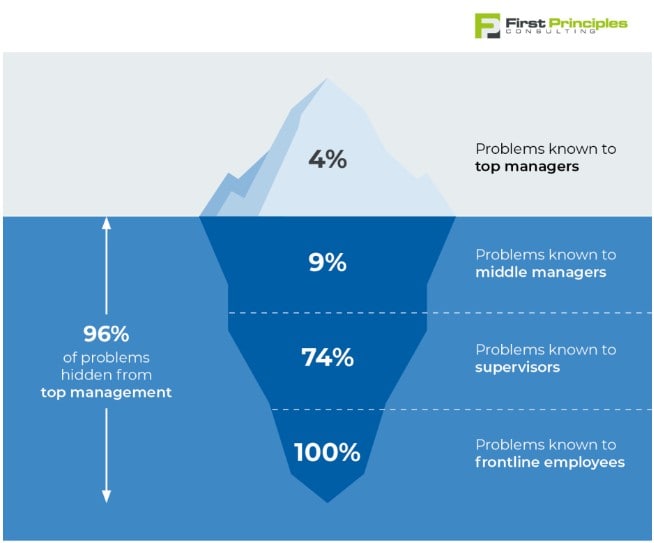
The boardroom only sees the tip of the iceberg so they can’t see why their strategic ambition is failing to materialise, only that it is. The question is: how do we invert the iceberg so that the boardroom can see the full picture?
Operational capability
This is the missing piece; the iceberg below the waterline. Operational capability is made up of all the tangible and intangible assets that turn strategic intent into a bottom line result. This includes: culture, data, plant and equipment, processes and technology. That’s why we call it the invisible engine that turns.
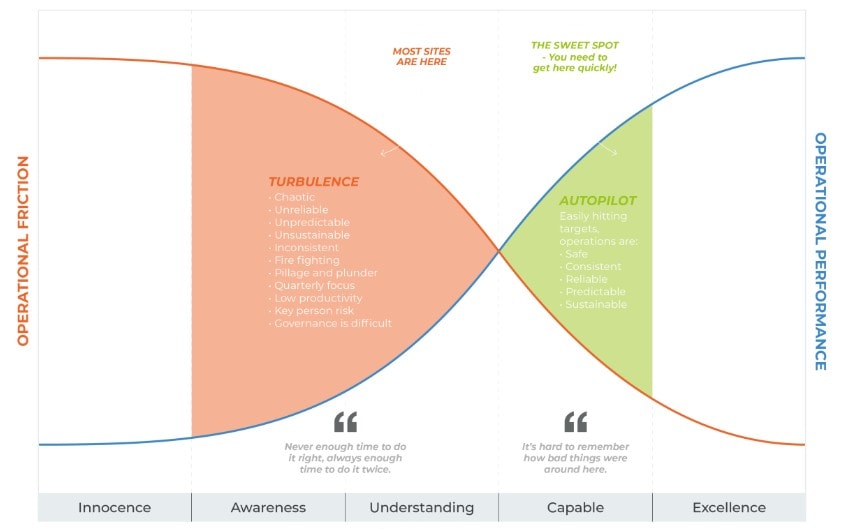
The maturity of this engine is measured on a scale of innocence to excellence which takes into account operational friction (drag) and performance (productivity).
While operational excellence is a great goal to strive for, it’s overkill for the majority of sites. Instead, we’ve found that practically, miners fall into one of two categories on the capability curve shown in figure 2:
- Turbulence: high friction, low performance.
- Autopilot low friction, high performance.
Strategic intent
If capability is what a site can do, strategic intent is the destination toward which the site is heading. It’s the long-term vision that describes why the company exists (beyond the financial) and what it ultimately wants to achieve. Strategic ambition is how audacious that intent is based on today’s performance.
Broadly speaking, there are three different elements that affect ambition:
- The timeline (how fast you want to achieve it).
- The target (the distance from here to there).
- The execution (does it require a fundamental shift in how you operate?)
Adjusting any of these elements will dial the ambition up or down. A bold setting is neither good nor bad on its own – ambition is only reckless when it isn’t matched by the required capability to deliver it. In fact, in order to grow, every strategy iteration must be more ambitious than the previous one.
So, how do we get the balance right?
Performance Quadrants
The answer lies in the Performance Quadrants, a simple 2×2 diagram that plots ambition against capability – shown in figure 3. Every mine site sits in a quadrant, whether it has thought about it or not.
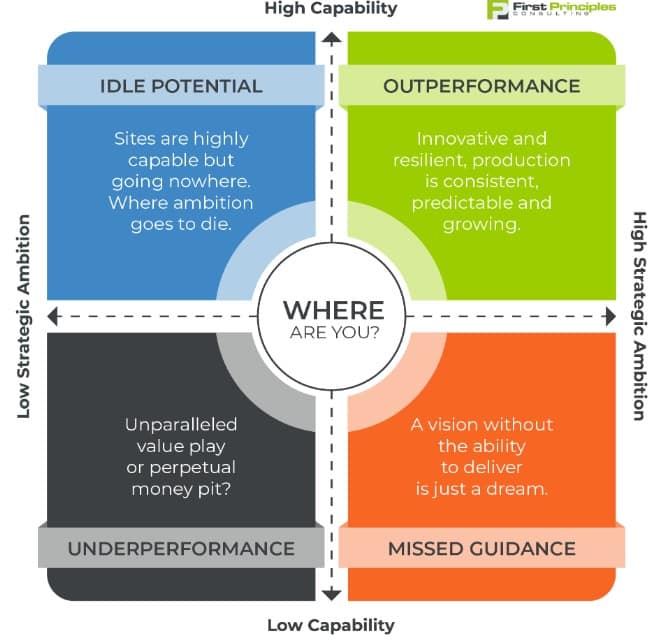
The quadrants are characterised as follows:
Idle Potential (high capability, low ambition): The site can deliver far more than it’s being asked. I don’t know of any mining company that inhabits this quadrant as it would soon be a takeover target or, more likely, face a shareholder revolt.
Underperformance (low capability, low ambition): The site can’t do much, and isn’t being asked. Quiet, unremarkable and going nowhere. These are often sites in care and maintenance, or on the cusp of it. Getting this turnaround right has the largest potential upside.
Missed guidance (low capability, high ambition): The boardroom sets targets based on potential, but the site doesn’t have the maturity to realise it without disrupting everything else. This is where most sites live, and it’s the most dangerous square on the board. You may know it as: firefighting, pillage and plunder, or ‘robbing Peter to pay Paul’. The upside is that this quadrant has the fastest path to out-performance.
Out-performance (high capability, high ambition): This is the sweet spot. The boardroom is ambitious, but can afford to be, because they know that the site can consistently and predictably hit their targets. When things go wrong, as they invariably do from time to time, the site is able to recover quickly, because it has the systems to respond rather than react. Sites in this quadrant attract and retain A-players, operate at lower costs and are better positioned to take advantage of commodity price cycles.
Fixing the right problem
When laid out in this way, it’s clear how the strategic intent is so frequently set in isolation by the boardroom. The iceberg explains how often this is done in complete absence of knowledge of the operational capability. When the boardroom tries to impose these lofty ambitions on the blast site, the pushback is often ignored and labelled as sandbagging in the erroneous belief the site just wants an easy life.
What’s needed isn’t another lever. It’s a holistic approach; an honest measure of the gap between ambition and capability, coupled with a deliberate plan to close it and matched with the requisite resourcing commitment.
So before you push the site harder, approve the capital, or reshuffle the organisational chart, ask the harder question: is this an ambition problem, or a capability problem?
If the site can’t yet do what you’re asking, more pressure won’t get it done. It will only prove, the hard way, what the blast site has been telling you all along, that the ambition and the capability don’t match.
Continue the conversation… Alexander Franklin is a Chartered Engineer, Managing Director of First Principles Consulting and author of Mining for Value. Using his global experience across high-stakes sectors Alex specialises in improving a site’s ability to reliably translate strategic ambition into bottom-line results. Connect with Alex on Linkedin
Click here to learn more about operational performance in mining.