


Trust is often considered the currency of our time. It serves as the foundation for institutions, governments, financial systems, and is vital in relationships with customers, business partners, communities and shareholders.
While traditional resources like money, data, and reputation continue to hold significant value, trust is what underpins their effective use and exchange. For mining companies, managing reputational risks has become a key concern in recent years.
Blockchain technology might not be the first thing that comes to mind when considering ways to build trust in the mining industry and across the mineral supply chain. However, my perspective changed after speaking with Tanya Matveeva, an exploration geologist with first-hand experience in blockchain technology.
Learning about blockchain’s potential to advance ethical conduct and responsible sourcing, as well as its ability to enhance trust by ensuring error-free data and democratising access to information was eye-opening.
The role of blockchain in securing data reliability
As an exploration geologist, Matveeva was introduced to relational database technology while working with large data sets. It was then that she realised, “Whenever humans interact with data, errors are inevitable. That’s why, in data management, the more computers and the less humans are involved in data processing, the better and more reliable the outcome.”
She further noted, “In addition to unintentional errors, deliberate data manipulation can occur, as seen in the recent scandal involving Red Pine Exploration Inc.” The company’s former CEO had manipulated exploration results from lab tests, which were then used to in resource modelling data and technical reports.
“One of the key advantages of blockchain technology,” Matveeva explained, “is that it minimises human interaction with data by storing and managing it across a network of participants. Participants can see if relevant data has been altered. While changes can still be made, the changes will be tracked, making it nearly impossible to conceal any data manipulation.”
Blockchain for minerals: digitalising physical objects
To use blockchain technology for tracing and tracking minerals, in a first step, physical objects (the minerals) need to be converted into digital objects that can be put on the blockchain-based platform. This can be compared to creating a digital fingerprint that functions as a unique digital ID and can be used to unmistakably identify the person.
There are, to date, two main technologies to accomplish this for minerals. One creates 3D scans of the actual material, like a rough diamond or a gold bar. This 3D-scan then becomes the digital fingerprint that cannot be changed or modified afterwards. This way, the pieces of mineral can be tracked along the value chain, and even if broken up into smaller pieces, the original ID is contained in these pieces.
Another way to create a unique digital fingerprint is to attach a QR code on packaged material, such as bags of cobalt concentrate, for example. While this may sound simple, the conversion of physical to digital objects is a complex step. Ensuring the digital fingerprint contains the right information and is attached to the correct physical object is key.
“Circulor, a company specialised in traceability via blockchain, started tracking bags of cobalt in the Congo. They tracked which area of the mine each bag came from using IoT devices on the trucks to monitor the routes and times it took to see if they were deviating from the prescribed route”, Matveeva explained.
“This was to ensure that the concentrate was solely coming from the industrial mine and not from artisanal illegal mining, which was what the automotive companies were demanding.
“An additional advantage is that companies can attach data on the CO2 footprint of material, such as the distance covered and fuel emissions, or the CO2 footprint of the crushing process and other parameters, so they can be tracked as part of enhanced environmental, social and governance (ESG) reporting,” Matveeva said.
Berlin-based MineSpider, for example, has launched a battery passport that uses blockchain technology to track the origin, production history, ESG metrics and carbon emissions at every stage of production for battery materials.
Tracking transport on blockchain-based platforms
Once the primary digital fingerprint is created and the initial information is captured and added to the blockchain-based platform, the rest of the supply chain can be integrated with relative ease, according to Matveeva.
“Where materials are moving, networks already exist, and some system is used to track information – like SAP, for example. This means that the various participants along the supply chain are already communicating and exchanging data, whether through email, paper documents, fax, or even cloud systems,” she explained.
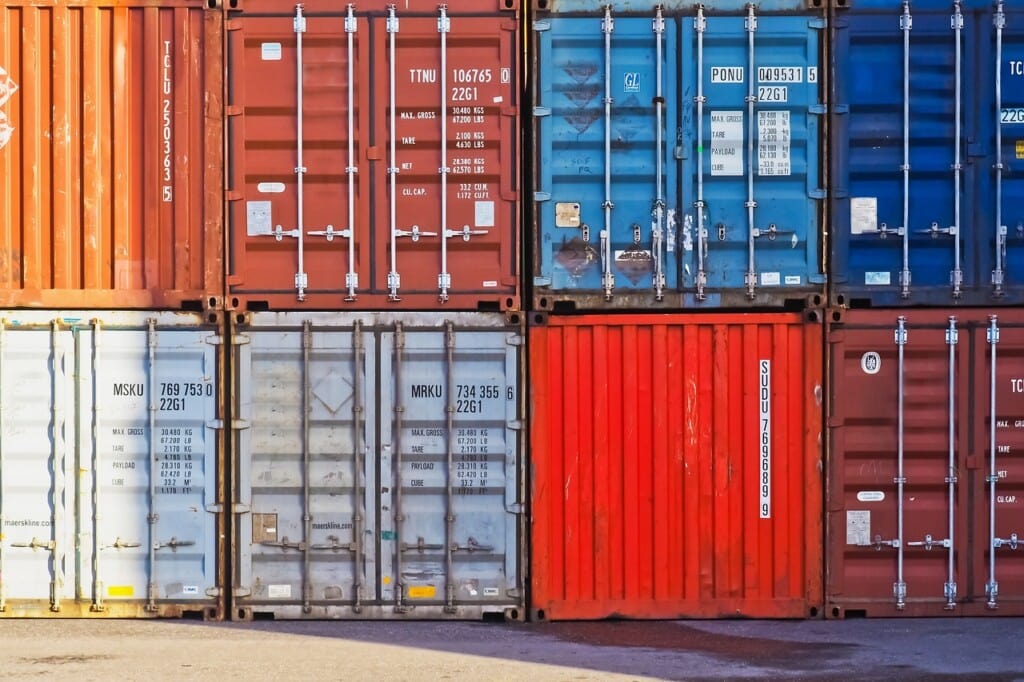
Moreover, blockchain integrates seamlessly with IoT devices that can follow, for example, the location of the shipping containers in real-time. Additional data, such as when a container was opened or closed, or its internal temperature, can also be monitored in real-time and stored on the blockchain. This information is then shared among network participants instantaneously.
MineHUB, for example, is already offering clients a system that revolutionised the tracking of bills of lading, and also allows for live shipment tracking, enabling all participants to see the exact location of a shipment at any given moment.
Because blockchain data is not only highly reliable but also decentralised and accessible to all network participants. “It creates a new level of information equality,” Matveeva noted. “When everything is tracked, it eliminates the need to argue about who did what, when and who is responsible, benefiting everyone involved.”
Building trust and accountability along the supply chain
This can have wider implications than ensuring traceability for the end-customer.
“In mining, there’s a lot of mistrust among the various participants in mineral value chains, such as exploration companies, mining companies, and traders,” Matveeva observed. “Some aspects of the supply chain and the intersections of different participants remain kind of a ‘black box’ that allows certain intermediaries to profit from merely controlling the flow of information.
“Blockchain technology was originally used to safely transfer bitcoins (digital currency) between participants directly, removing intermediaries (banks). The potential I see in mining is that it can play an important part in building trust through transparency by ensuring that companies always work with original data.”
Technically, blockchain has the potential to connect producers and buyers more directly, which could not only increase transparency and traceability of data, but also the fairness in value creation and even profit sharing.
“As minerals pass through the value chain, it’s not the people doing the hardest work that are earning the highest profits,” she reflected, “and blockchain could help change that.”
It should be noted that once material reaches the processing plant where it’s smelted, the same digital ID cannot be maintained. However, there are ways to ensure that minerals are sourced ethically and sustainably.
“Smelters can take a concentrate from a certified source and, say, 90% of material comes from certified sources,” Matveeva said. This is comparable to fair trade coffee, which is already widely traced via blockchain.
“The idea is that guaranteeing a certain percentage of certified material in the products could justify higher prices for premium materials,” she added.
The role of trust in adopting blockchain technology
While there’s clearly immense potential for implementing blockchain in mining, hesitancy remains. One reason could be that, ironically, adopting blockchain itself requires a certain level of trust.
“Because blockchain is based on a decentralised database, it can feel like it takes control away from individuals. And in a way, it does,” Matveeva explained. “Think about how long it took us to trust Google Maps to guide us – it’s similar to that.
“When we first learned about email, could we have imagined today’s Zoom calls or storing all our data in the cloud? That’s where blockchain is right now. The technology exists, but we’re not fully utilising its potential or seeing all the possibilities yet.”
It takes trust to get all participants on board with a distributed network. But once a blockchain-based platform is established, everyone benefits from the enhanced trust that comes from transparent tracking and tracing.
The future of blockchain in mining: a path forward
Despite the challenges, Matveeva is optimistic about blockchain’s future in the mining industry. “The potential is there, and I believe blockchain will eventually be adopted more widely,” she said.
“Currently, market penetration is wide but shallow on the upstream side – every large mining company is exploring blockchain-based solutions. On the downstream side, OEMs are exploring blockchain-secured battery passports, but there’s no integration yet along the supply chain.”
In contrast, other industries like oil and gas, or even the food sector, have embraced the technology more boldly, developing a wide range of solutions and holding annual blockchain conferences. It’s a level of adoption that Matveeva hopes to see for mining in the near future. She considers blockchain as an essential tool for creating a more interconnected and integrated mining industry.
“To continue to grow and flourish, the industry needs to foster trust between different stakeholders and supply chain participants. Blockchain technology can be a strong enabler of that trust,” Matveeva emphasised.
One key component to achieving this trust, according to Matveeva, is minimising human input into data management. “I truly believe that minimising human interaction with big data is key to ensuring the mining industry meets the increasing demands for transparency and accountability,” she said.

Yet, the road to broader adoption is fraught with obstacles. “Often, I hear people say, ‘You’re trying to sell a solution for a problem that doesn’t exist’. Like blockchain is just some shiny new toy,” Matveeva remarked.
“Lack of understanding and information are barriers. Smaller companies may lack capacity to explore new technologies. And, of course, there’s a lack of trust and a resistance to change.”
Still, Matveeva believes this hesitation is only temporary. As more companies and industries adopt blockchain-based solutions, the benefits will become undeniable.
“Improving trust between participants of the mining supply chain benefits everyone,” she explained. “It has become even more vital in the face of resource protectionism, because we end up mining low-grade ores just because they’re within particular political boundaries, instead of mining the best deposits in the most efficient and least harmful way.”
In the end, Matveeva sees blockchain as part of a broader solution to global challenges. “We’re one humanity, sharing one planet. Climate change discussion has made that clearer than ever,” she said.
“We all need to behave responsibly, so we don’t ruin our environment. Blockchain technology offers efficient, reliable solution for ethical, transparent, sustainable, and efficient global resource management.”
Learn more about blockchain in mining:
- www.blockchaininmining.com
- https://www.riotinto.com/news/releases/2021/Rio-Tinto-launches-START-the-first-sustainability-label-for-aluminium-using-blockchain-technology
- https://www.bhp.com/news/bhp-insights/2021/12/three-big-questions-blockchain-is-helping-us-answer
- https://www.minespider.com/press/society-artisanal-partners-with-minespider-to-track-conflict-free-artisanal-gold-from-the-drc
- Talon adopts Circulor’s tech to trace responsibly sourced minerals (mining-technology.com)
- MineHub Announces Expansion of Partnership with Sumitomo Corp
3 comments
Ceguro
I am learning about alternative uses for blockchain (outside of fintech), and this is another innovative use of the technology. I had a conversation with someone at the design blog, where they were exploring it’s use in user-generated video game content, for example. Musicians are looking into it. A lot of ownership and tracking potential there. The cobalt example raised in the article is a good point, and of course yes, it’s not perfect, but it’s an interesting step to take. If legitimate producers all jump on board to using blockchain tracking, it could cut down on materials being injected into the supply chain that are from illegal sources. It could also give us an interesting view into what it actually takes to mine or produce many of the minerals we use in manufacturing, giving us a more accurate view of the ‘cost’, in terms of energy use, pollution, etc. For this to be useful, it has to be resilient against tampering, which is blockchain’s strength. Not that it is immune, but it is more resistant than any other technology to date.
Very interesting article on a use I had not imagined!
John S. Metzger
Respective of the Cobalt shipments. Bags need tags, or isotopes that are tracked from origin to end user. Once a truck arrives in trans-shipment, bags and whole loads can be mixed, intermingled or stolen and replaced without the ongoing provenance secured.
Tanya M Matveeva
John, you are correct, and there is not, so far, a perfect solution, but if a big part of cobalt can be tracked, then it is harder to add illegal material into the mix. Just like tags for tin bags made it harder to introduce illegal production, but of course people found ways to steal and sell the tags, but it just made it so much harder. The blockchain-secured tags add a next layer of complexity.