

Population growth and the transition towards clean energy are driving demand for metals and minerals at an unprecedented rate. The mining industry is under enormous pressure to deliver, but is facing significant challenges, including decreasing ore grades, fewer new discoveries of world-class deposits, and increasing environmental and social regulations.
In addition, at a macro level, the mining industry has seen significant fluctuations in capital investment over the past 10 years, driven by commodity price cycles, economic conditions, environmental regulations and technological advancements. Uncertainty caused by these fluctuations makes it a very challenging capital-raising environment, particularly for junior mining companies.
Many of the challenges the mining sector faces today, are the result of its historical focus on large-scale deposits. But what about the smaller deposits?

Bigger isn’t always better
Due to the ‘clustering effect,’ there are many more small-scale mineral deposits than large-scale, tier 1 or tier 2 deposits. Many of these are narrow vein or lode-type mineral deposits of various styles around the world that exist on the periphery of established projects, zones within operating mines or standalone deposits.
As a result of their shape, orientation and size, they’re often deemed uneconomic and left unmined. This is because an open-pit approach generates too much waste, while underground mines require lengthy and costly development which quickly erodes project returns even if the deposits are high-grade and contain a tremendous amount of in-situ value.
Novamera has developed a Surgical Mining method to target and extract these types of deposits while generating minimal waste and requiring very little development. This is achieved by combining proprietary software and hardware solutions with conventional drilling equipment to quickly, efficiently and sustainably move into production.
How does Surgical Mining work?
In the pre-production, planning phase, Novamera uses a unique software to rapidly generate multiple mine plans with various operational and capital-related options. This maximises project economics by running hundreds of scenarios to determine the drill plan that extracts the most value depending on the parameters that are being optimised.
When production begins, the desired mine plan is still based on historical drilling and relatively widely spaced holes, which is not optimal for surgically extracting narrow vein deposits given the potential variability in the deposit. Therefore, Surgical Mining employs a two-pass sequence of imaging holes in tighter spacing with Novamera’s Guidance Tool and then extracting the ‘vertical bench’ using a large diameter drill.
While in production, the Guidance Tool is deployed on a standard diamond core rig, down-dip, parallel to the orebody. It scans laterally for about three to four metres in radius around the borehole at 1.5 linear-metre intervals downhole, picking up contact points or interfaces between mineralised zones and wall rock.
Using advanced algorithms and machine learning, a 3D model of the orebody can be created that accurately shows the vein’s geometry, shape, and continuity (or lack thereof). This process captures 4,900% more data (for the purpose of determining higher resolution orebody geometry) than traditional cross-cutting drilling at a fraction of the cost.
With the higher resolution orebody model, the mining company can alter, in real-time, the drill plan and extraction angle to match the true orebody geometry and dip angle.
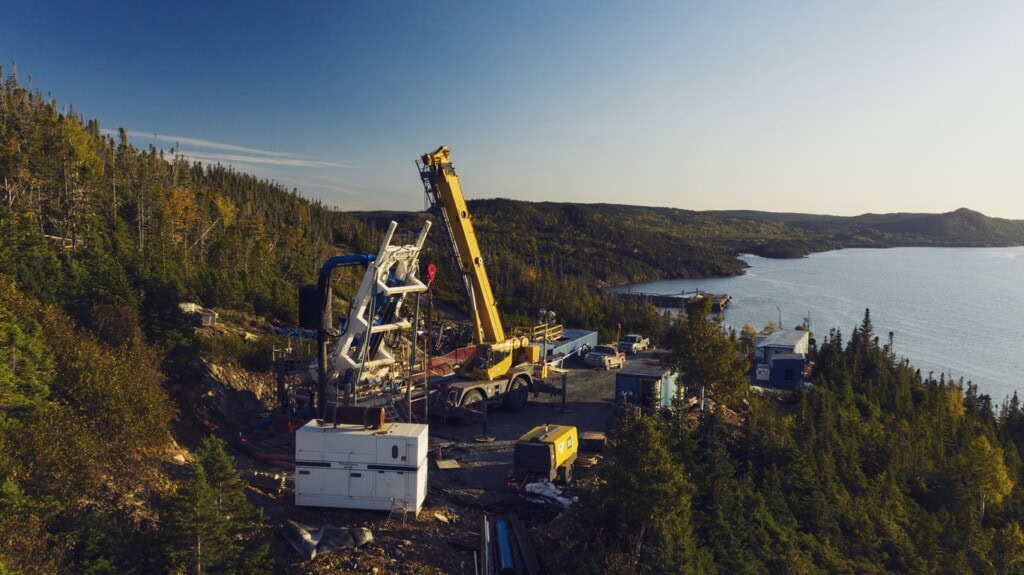
The Smart Drilling System, which includes a Positioning Control System and Course Correction Device, is paired with a large-diameter drill (+/- 2m diameter cutting head) to maintain the prescribed extraction trajectory in the second pass of the production sequence.
The large diameter drill (a pile-top-drill rig for surface applications) uses reverse circulation with airlift assist to bring ore efficiently to the surface, where it can be transported to a mill for processing. Cuttings are typically 7 to 12 millimeters (cutting tools can be engineered to target desired size fractions), allowing the material to bypass primary crushing.
This two-pass sequence of imaging and drilling continues down the strike length of the vein, with holes backfilled with a low strength paste-fill using tailings from processed ore. Backfilling stabilises the ground while extracting from adjacent holes and provides real-time reclamation.
Reduced capital requirements
There is significantly less upfront capital and development required for a surgical mine – roughly a quarter of a conventional underground operation. In addition, most of the capital can be moved and deployed to other deposits.
Combined with a faster path to production, the positive cash flow comes sooner which supports a better return on investment. This can also allow juniors to get into production on a smaller scale and in a cost-effective manner, and fund future exploration, without having to rely as heavily on capital markets.
Faster permitting
The average permitting timeline for a traditional new mine, according to the International Energy Agency, is about 16 years, with an additional 10 years being the average time a new mine takes to achieve full-scale production.
With Surgical Mining, minimal surface disturbance, low water discharge and significantly reduced waste combined with the fact that there is no blasting, reduce some of the biggest contributors to lengthy permitting and make this process more palatable to host communities.
Additionally, there are many small-scale regulatory mining provisions that already exist globally. Many of these allow miners to bypass environmental impact studies required for larger scale mining.
After a successful full field demonstration in 2021, Novamera has developed a growing pipeline of Surgical Mining projects that include both critical minerals and precious metals. The Guidance Technology is currently being deployed with commercial customers in North and South America, with the complete turnkey Surgical Mining solution scheduled for a bulk sample in Newfoundland in early 2025.
Unlocking new production
The industry needs to start to consider new methods of mining to help support the world’s growing demand for minerals and metals.
Innovative technologies and processes, like Surgical Mining, are key to unlocking new possibilities, providing more flexible, cost efficient and sustainable options and helping mining companies to get into production faster.
Continue the conversation: Dustin Angelo brings decades of experience in mining, capital markets, business strategy and innovation. Prior to co-founding Novamera, Dustin was President, CEO and Director of Signal Gold and was responsible for expanding operations and building a profitable, sustainable company with a culture of environmental stewardship.