

The mining industry, like many others, is still in the early stages of artificial intelligence (AI) adoption, observing and analysing, rather than fully utilising the capabilities these technologies offer.
While we are all grappling with the speed of AI development, another potentially even more impactful technology is making its way to the surface: humanoid robotics.
“… we are close to Artificial General Intelligence, but we are also close to Artificial General Robotics,”
stated the CEO of Nvidia, Jansen Huang, in November 2024
A brief history of robotics
The development of automated machines that can perform work like humans and help with hard or repetitive labour goes far back in human history. In 3000 BC, the ancient Egyptians automated water clocks using a human figurine to strike the hour bell, ringing out the time of day, while in 100 AD, Roman officials built a doll that could move like a human.

Since then, inventors in different parts of the world have continued to produce their versions of automated machines, sometimes to perform work, but often just to showcase their craftsmanship.
More recent inventions in computer science led to the development of programable controllers and AI, moving robotics to the commercialisation phase. The first commercially available robot, Unimate, was an automated robotic arm installed at General Motors’ car assembly plant in 1961.
Academic research progressed alongside commercial adoption, resulting in the development of more sophisticated robots. Researchers at Stanford University in the 1970s developed a mobile robot that was capable of reasoning, which became the basis for further development of AI-powered autonomous robots.
These developments unleashed the adoption of robots in industrial applications. According to the International Federation of Robotics (IFR), 4.3 million industrial robots are currently in use worldwide.
The automotive industry is leading the adoption with over one million installed units, followed by electronics, metals and machinery, plastics and chemicals, food, logistics, healthcare, agriculture, construction, and pharmaceutical industries.
Over the past few years, the mining industry has also started to introduce autonomous robots, mainly for surveillance applications. (Note: autonomous vehicles are not considered robots)
The rise of cobots
Industrial heavy-duty robots are typically placed in restricted zones, made inaccessible to humans to ensure safety and prevent injuries. The need for robot-assisted human work led to the development of collaborative industrial robots or ‘cobots’.
Cobots and humans can work on the same task and share the same workspaces. Safety layers in design and operation are added to cobots to prevent injuries to humans.
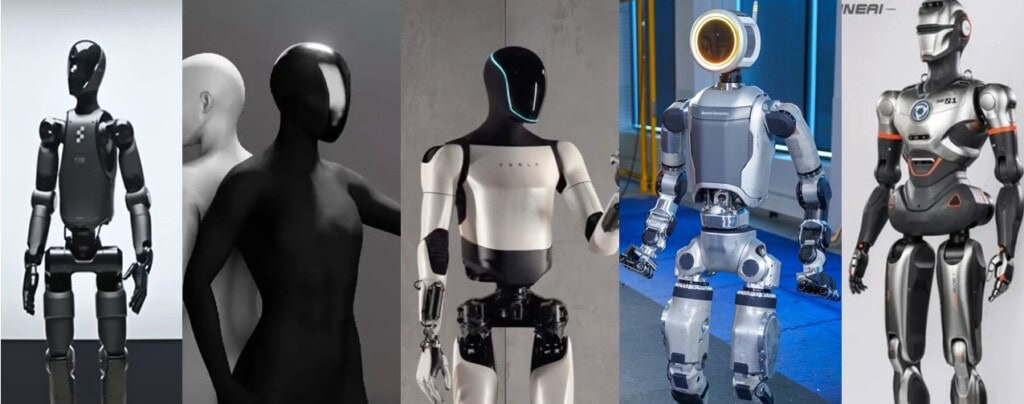
The latest advancements in robotics are also bringing increased attention to general-purpose humanoid robots. Humanoid robots can increase automation levels in industrial and logistics settings without major facility modifications replacing human work.
Humanoid robots designed for industrial applications typically feature advanced mobility, dexterity and sensory capabilities. Articulated limbs with good dexterity allow them to perform tasks with high precision.
Vision and tactile sensors provide feedback signals so that the robots can recognise objects and adjust their movements to interact safely with humans and the environment.
Developments in the past few years have made the commercial application of humanoid robots in industrial setting possible. Some advanced humanoids robots are now available for commercial use, while others are in late-stage development and testing ahead of full commercialisation.
The price range at the time of writing (February 2025), either as a target or actual cost for most models, varies between US$12k and $200k, although possibly more as some of the models listed below are not yet available.
Humanoid robots for industry
The following partial list illustrates some of the humanoid robots currently available and under development.
- Boston Dynamics has been developing robots since the early 90s. The company’s humanoid robot, Atlas, can perform complex tasks such as walking, running, jumping, and even backflips, thanks to its sophisticated control systems and state-of-the-art hardware. In 2024, Boston Dynamics announced the release of a fully electric version of Atlas, making it suitable for industrial, construction and logistics settings.
- Tesla introduced the Optimus general-purpose humanoid robot in 2021, incorporating its advanced AI models. Tesla plans to release Optimus for commercial use in 2025, with the robot initially being deployed in Tesla’s own factories before it becomes available to other industrial and general customers. Tesla is aiming to produce 10,000 units in 2025, with a target price in the range of $20-30k, making it affordable for fast adoption.
- Figure AI F02 humanoid robots entered the news when the company announced a commercial agreement with BMW in January 2024. F02 can carry loads of up to 25kg and interact through a microphone and speakers, leveraging a custom AI model based on the Open AI platform. A new model, Helix, is based on a Vison-Language-Action model that operates locally, on-device (F02 is cloud based). This is a significant improvement providing an additional level of autonomy.
- Clone Alpha humanoid robots are the next step in biomimetic robotic development. This robot integrates synthetic organs and artificial muscles, mimicking human skeletal, muscular, vascular and nervous functions. It features advanced Myofiber artificial muscles which provide fluid, human-like movement powered by water. Alpha is primarily developed for domestic use at this stage, but it should be easily adaptable for the industrial environment as well. Commercialisation is planned for 2025 with a limited release of 279 units.
- Sanctuary AI’s Phoenix general-purpose AI humanoid robot got its eighth upgrade at the end of 2024, including added telemetry for enhanced data capture, vision and cost optimisation. Phoenix has a wheelbase rather than legs to support its torso. Magna International Inc, an automotive parts supplier, partnered with Sanctuary AI in 2024 to deploy Phoenix at its manufacturing facilities.
- Agility Robotics’ Digit is fully autonomous and capable of handling various tasks such as sorting, lifting, and transporting packages, with a load lifting capacity of up to approximately 15kg. The latest version is expected to be released in 2025 at a lower price compared to the previous model that costs $250k.
- The NASA Robonaut project started in 2011 at the International Space Station, making this robot fit for restrictive environments. The R2 version was developed in collaboration with General Motors, expanding its use to the automotive industry. There are no current plans for commercial release.
- 1X Technologies’ Neo is an advanced, full-scale humanoid robot designed for industrial and domestic use. Neo can walk, run and lift a load of up to 20kg. 1X Technologies plans to release Neo for commercial use in 2025, with an estimated price of around $40k.
- EngineAI SE01 is a full-sized humanoid robot designed for industrial, research and other general applications, with highly flexible movement capabilities. SE01 has an end-to-end neural network system creating a natural, human-like gait. SE01 is commercially available at the price of approximately $12k, making it attractive for wide adoption.
- Unitree H1 is a full-sized humanoid robot designed for industrial and research applications. With highly flexible movement capabilities, H1 can interact with its environment effectively. It is commercially available, with a price of $90k.
Not if, but when
The emergence of humanoid robots with capabilities comparable to humans will have a significant impact on the work environment and society in general.
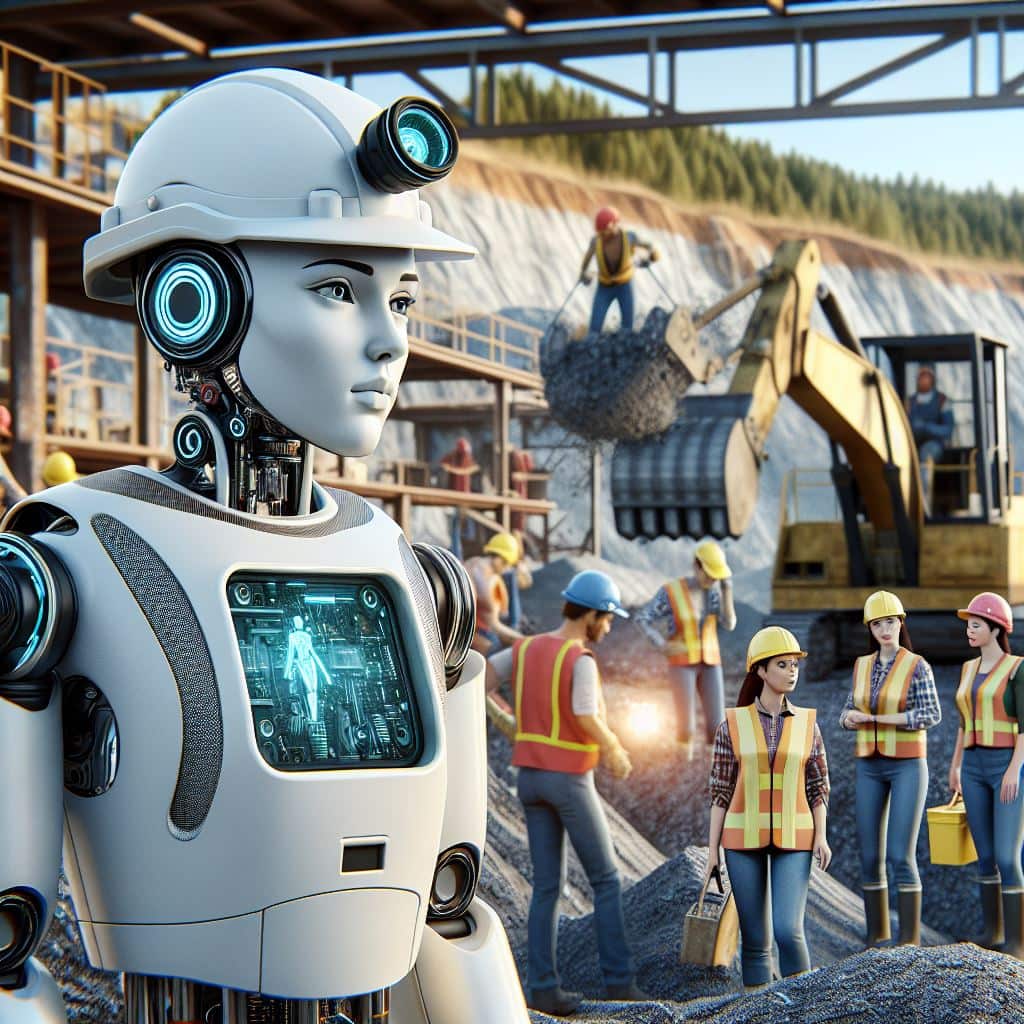
Terms such as ‘synthetic humans’ and ‘digital worker’ will soon start popping up in our everyday language and at our workplaces. As discussed above, a few advanced humanoid robots are set for commercial release in 2025, some of them at an affordable price that will propel the adoption process.
The introduction of new technologies is always accompanied by fear of job losses, but historically, new technologies have improved workplace safety and created new types of jobs.
The proper adoption of robotics should focus on positions where people are exposed to harsh conditions and repetitive tasks, to bring a new level of safety and attract workers with different skill sets. This shift is especially relevant to the mining industry where work conditions can deter many people.
The mining industry could and should take advantage of these developments. As a colleague of mine said recently: “I need help lifting the core sample box, not a bot saying: ‘how can I help you?’.
It seems that 2025 might be the year when this help will become available.