

In 2023, mining tyre service provider, Kal Tire, published a watershed paper on the recycling of mining and off-the-road (OTR) tyres. In it, Dan Allan, SVP of Kal Tire’s Mining Tire Group, made the case for greater uptake of recycling and explained how, contrary to popular belief, these solutions can add long-term value to mining businesses rather than additional costs.

I’ve long admired the company’s forward-thinking nature and commitment to sustainability. As a member of the trade media, I’ve watched over the years as the team has innovated and partnered to create an offering that encompasses the full tyre lifecycle, from supply to operation, retread, reuse and recycling.
The latest piece of the puzzle – a new carbon ash refining process plant, which will soon be operational at Kal Tire’s mining tyre recycling facility in Antofagasta, Chile – completes the loop, allowing refined carbon from end-of-life mining tyres to be used in the manufacture of new ones.
It was high time we had a catch up, and Terry Galvin, VP of Recycling Services, was just the man for the job.
Making recycling achievable
“What’s changed in the market since 2023?” I asked him.
“There’s been a noticeable shift in mindset on recycling,” he replied. “More miners are actively exploring solutions for end-of-life mining tyres.”
According to Galvin, this is being driven by several factors. First, sustainability is a topic that remains high on mining companies’ agendas. Although regulation is fuelling the uptake of recycling in jurisdictions, like Chile, Kal Tire is also seeing interest from companies in regions, including Africa, Australia, Canada, which do not yet stipulate how miners should manage their end-of-life tyres.
These companies are essentially ‘self-mandating’, which shows that recycling solutions are becoming more practical, accessible and tangible.
“Interestingly, this drive isn’t just coming from corporate governance, it’s being requested at the operational level by boots on the ground,” said Galvin. “That’s cool, because it shows that sustainability and environmental, social and governance (ESG) initiatives are moving beyond targets into real action, and that people at the site level understand the importance of driving change through responsible practices.”
Staying true to circular aims
Kal Tire is no stranger to innovation – the company has strong sustainability ethics and developed the thermal conversion recycling technology and equipment used by its plants across the globe, rather than opting for existing pyrolysis or devulcanization based processes.
It’s Antofagasta mining tyre recycling facility uses heat in the absence of oxygen to process scrap tyres up to 63” diameter (the largest size class available) in thermal reactors.
To give you an approximation of scale, breaking down one 63” tyre using thermal conversion produces approximately 1,600kg of carbon ash, 900kg of high tensile steel, 2,000 litres of petroleum-based products, and 350 cubic meters of synthetic gas. The latter is fed back to the plant to power its operation, and Kal Tire sells the steel and oil that it recovers.
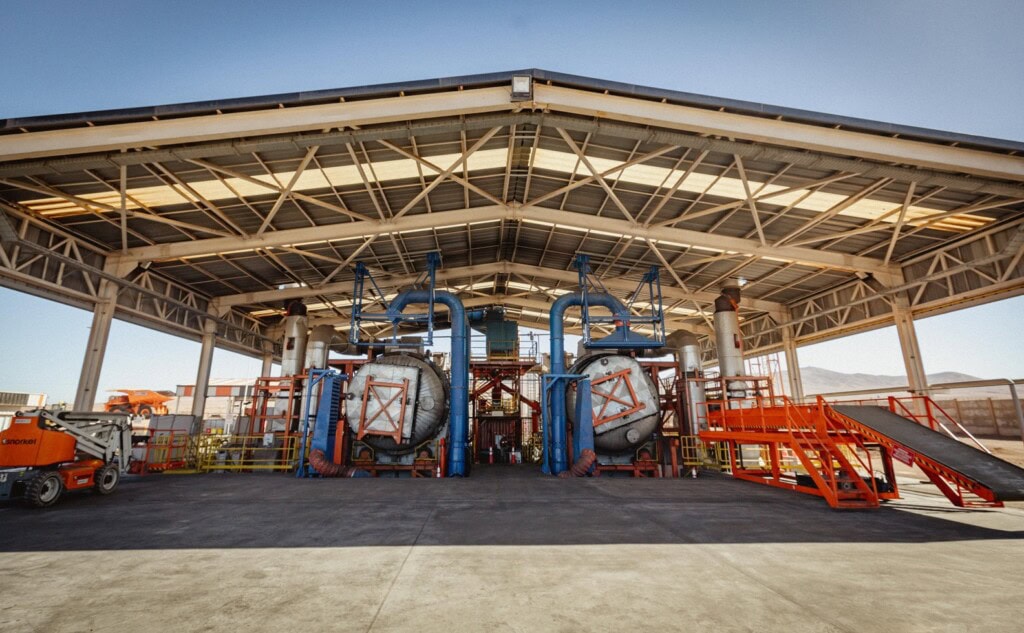
Rather than sending the carbon ash recovered from its recycling facilities to the production of tyre-derived fuel (TDF), Kal Tire instead chose to partner with a Canadian engineering firm to develop a new refining process.
This will allow the carbon ash to be turned into high-quality recovered carbon black which can be fed back into the manufacturing of premium mining tyres and other rubber products, like conveyor belts.
Knowing this solution was in development, Kal Tire has stockpiled the carbon ash produced by its Chilean recycling facility since it opened three years ago and has offtake agreements in place which are awaiting the first shipments of recycled carbon black.
“Why go to the effort and expense of developing a new refining process, when other options already existed?” I asked.
“Our mission from day one has been to put all the materials that we recover from recycling to their highest and best use, with an aim on true circularity,” Galvin explained. “TDF, shredding and crumbing (which allow the rubber to be used in asphalt and other applications) do not meet that intent.
They’re just delaying each tyre’s journey to landfill and shifting the problem of waste management further down the supply chain.
“But there’s so much more potential held within tyres, and carbon upgrading paired with a circular business model is key to unlocking that.”
Offsetting emissions, eliminating waste
The world produces around 15 million metric tonnes of carbon black each year, mainly for use in tyre manufacturing. Around 1.5 tonnes of fossil fuel derived raw materials and large amounts of water are used to produce one tonne of carbon black and, during manufacturing, approximately 2.5-3.0 tons of CO2 emissions are released per tonne of carbon black produced.
Anything that can be done to offset this level of consumption and emissions can only be a good thing.
For example, if a tyre can be kept in operation for longer through good maintenance practices, and repair and/or retreading, that will help to reduce demand for primary production.
Likewise, recovered carbon black can be used to lower the need for new carbon black and prevent waste tyres from being buried or stockpiled on site (an environmental and health and safety hazard in itself), which is a double win.
“Often, people think circularity is just about creating one circle,” said Galvin. “But some materials can be recycled and reused multiple times or in perpetuity. The more circles we can create from each product stream, the better off the industry will be economically, environmentally and socially.”
The raw carbon ash produced through tyre recycling contains various contaminants, and its quality and structural integrity aren’t of high enough standards for use in the production of new materials, hence the need for a refining step.
Tier one manufacturers and compounders also have high purity standards which preclude the use of lower-quality recovered carbon blacks in their feedstocks.
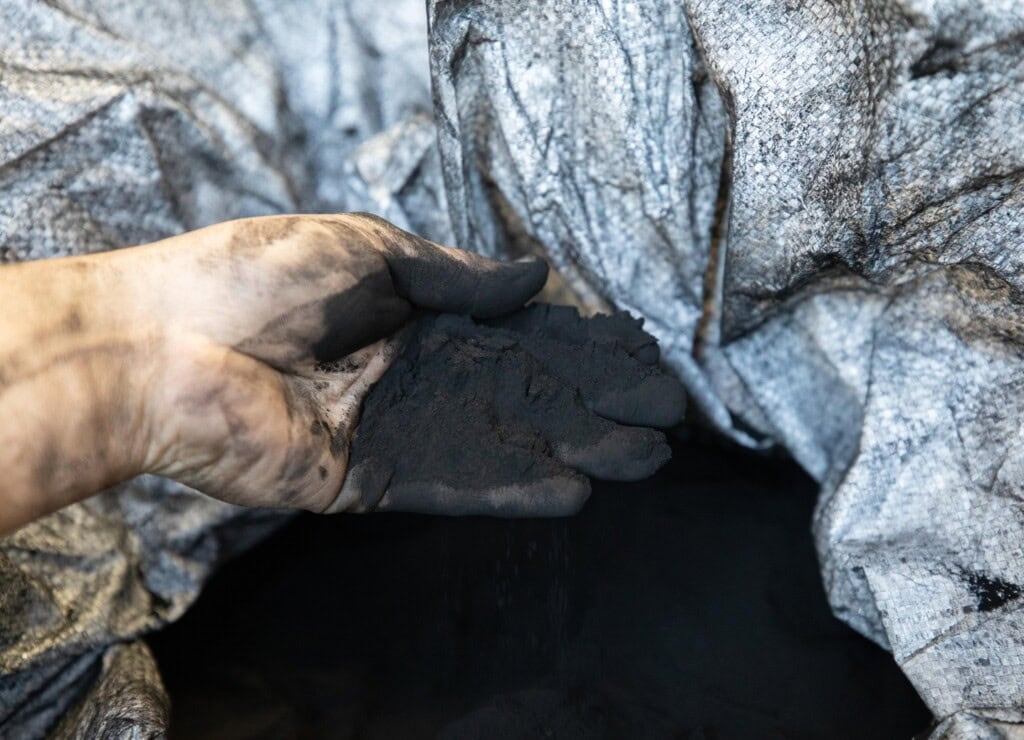
“Our recovered carbon meets those high purity standards,” said Galvin. “Once thermally converted, mining tyres are very amenable to being separated into their constituent components, unlike some products, like batteries, where only a portion of the materials can be recovered and reused.”
Creating new value
While recovered carbon black will likely never fully replace virgin material in the production of rubber-based products, the availability of a high-quality recycled feedstock provides manufacturers with options as they seek to decarbonise their own supply chains and raise the sustainability level of their own products.
Traceability and transparency are essential, and the feedstocks produced by Kal Tire’s Antofagasta facility are certified by the International Sustainability and Carbon Certification (ISCC) as circular, so downstream customers can be confident in the provenance and quality of the materials they source.
“There are massive quantities of spent mining tyres piled up or buried at sites around the globe that miners will inevitably have to deal with when operations close,” said Galvin. “Given the number of tyres and the materials that can be recovered, as an industry we could certainly make a strong impact on the global market as uptake of recycling services increases.”
For miners, the most important advantage is that recycling allows them to start progressive reclamation of their sites concurrent with operations; companies no longer have to wait until closure before figuring out what to do with their waste tyres.
Shaping the future of mining together
When Galvin and I spoke in June 2025, Kal Tire’s new carbon refining plant was entering the final stages of construction and was preparing for commissioning. The plant has been sized to match the throughput of its Antofagasta recycling facility and the two are co-located to minimise transport and logistical hurdles (and costs) for these massive tyres.
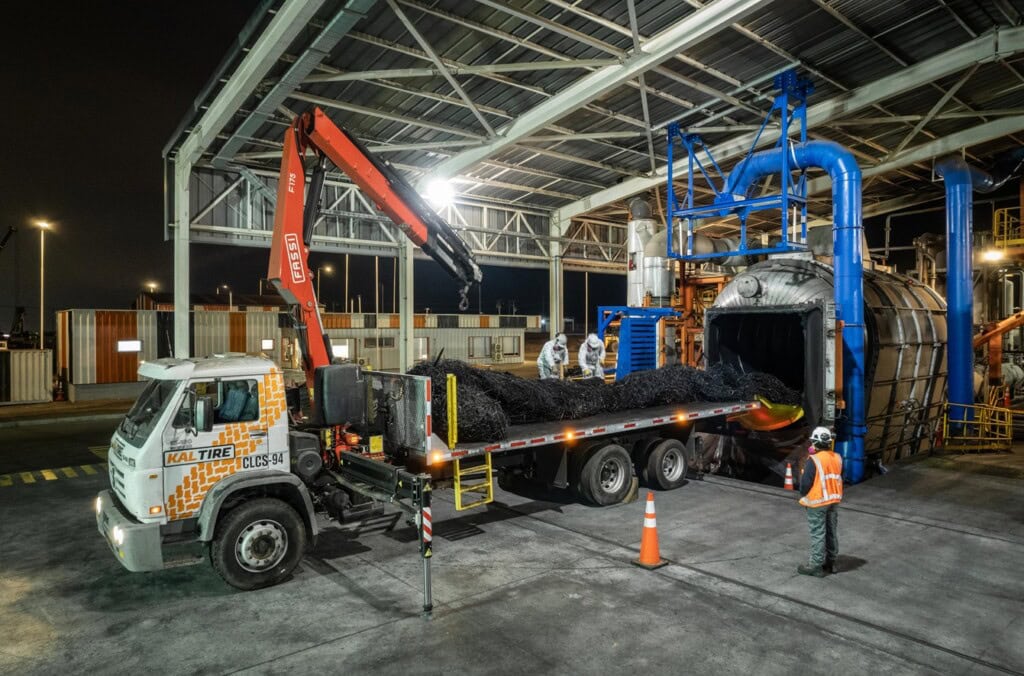
“From research and development to construction and setting up a local supply chain, there’s been a lot of complexity involved with creating this new processing facility,” Galvin told me.
“Getting to this point has been a collaborative process. It’s taken a lot of time, investment and careful consideration to stay the course and remain true to our values, but the results are worth it.”
Ultimately, circular economy offers mining companies the scope to create value outside of the traditional take-make-waste paradigm; it brings a whole new meaning to being a resource provider.
“I think that’s awesome,” said Galvin. “I grew up in a small mining town in Western Canada. There was a mine and a sawmill, and those operations existed to take resources away. That was 30 years ago, and now that they’re closed, there’s not much opportunity left in the area.
“But circular solutions create a new dimension of opportunity from what would otherwise be a waste stream, including economic and environmental restoration and skills development for local businesses and communities. They provide a new model for resource industries, like mining.
“The paradigm shift that can be supported by technological developments like ours across this domain is huge. The next 10-15 years will be an interesting time.”
More than tyres…
Following commissioning and successful operation, upgrading will become an integral part of the thermal conversion solution. The process and equipment are modular and easily scaled.
“We’ve seen a lot of interest from different jurisdictions,” said Galvin. “There are lots of other mining products that could benefit from a circular lifecycle too, and not all of them require the development of new technologies.”
“There’s no point reinventing the wheel if you don’t have to…?!” I offered.
“The tyre space is full of terrible jokes. That’s what makes the world go round,” Galvin countered with a grin.
“But also, it’s cool to have somebody, like yourself Carly, who’s come along for the journey, has seen the whole process and can help us reflect on how far we’ve come.”
“It’s been a privilege.” I replied. “It’s very satisfying when an article on circularity comes full circle.”
This article is sponsored by Kal Tire
1 comment
johnmetzger0ff608688d
Seeing the tire graveyards at the bottom of pits and waste dumps over the years – makes this an impactful and powerful opportunity for a global effort!