

Just as a croissant depends, not only on the skill of the baker, but also on pastry flour milled to precise specifications, advanced manufacturing whether for energy or defence applications, cannot exist without critical materials.
We often forget the ‘flour mills’ of industry — the midstream — where processing, refining, and converting in turn mineral concentrates, industrial wastes or recycled feedstocks into the materials that manufacturers rely on.
It’s here, not in the mine, where much of the value is created, and where the greatest economic opportunity lies for Canada and its allies.
Beyond mining: the aluminum lesson
Canada’s experience with aluminum illustrates this point. Today, Canada is one of the world’s largest producers of low-carbon aluminum, supporting supply chains in automotive, aerospace, construction and packaging.

Yet Canada has no aluminum mines, all raw material feeds are imported. The strength of this sector lies not in extraction, but in refining, recycling, and converting — in other words, the midstream, where energy and chemicals meet minerals and other feedstocks.
Of Canada’s 34 ‘critical minerals’, only 3–4 are truly minerals; the rest are elements which require extensive refining to produce.
Our narrow focus on mining critical minerals risks missing the broader economic opportunity the midstream presents and leaves strategic gaps in value chains.
To leverage this opportunity, investors and business leaders must consider the complex variables of different market dynamics.
For example, the distinction between broadly traded commodities, such as silver and copper, compared to the direct-to-customer off-take agreements for specialty materials like lithium chemicals and rare earth element feeds.
Those business leaders and investors who do not understand these dynamics and remain solely fixed in a commodity supply push paradigm will be left behind.
Where chemistry meets feedstocks
Critical materials are not commodities. They are specialty materials produced to tight customer specifications.
This production occurs in the chemical and metallurgical industries, where feedstocks from mines, recycling, or industrial wastes are refined and converted into essential material inputs which are enablers of advanced manufacturing.
Here lies both the opportunity and the vulnerability of our economy. Decades of de-industrialisation have eroded refining and chemical capacity.
Supply chains for reagents and precursors are thin and under-recognised, yet chemistry is foundational to processing and producing battery precursors, semiconductors, magnet powders and clean energy materials.
Without robust midstream refining infrastructure, Canada and many of its allies risk continued export of resources while importing high-value materials and components that underpin advanced manufacturing.
Analogy: farm → mill → croissant
Mining is the wheat farm.
The midstream is the flour mill.
Advanced manufacturing is the croissant.
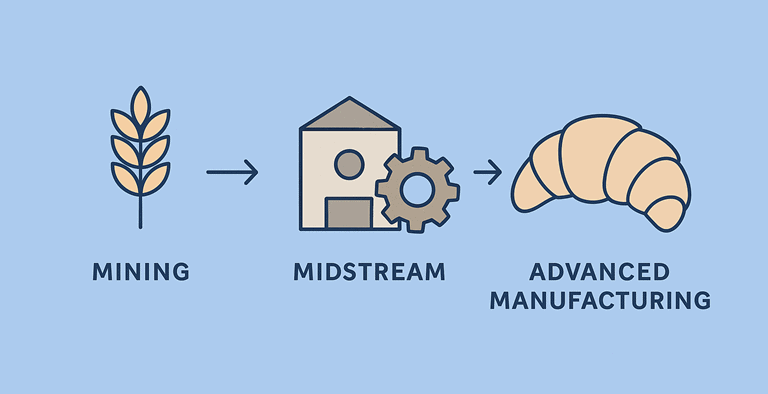
Just as wheat must be milled before a baker can make pastry, minerals and other feedstocks must be refined and converted before they can become batteries, chips, magnets, turbines or clean technologies.
Skipping — or outsourcing — the ‘milling’ step leaves Canada and our trusted trading partners dependent on others. China understood this decades ago and leveraged midstream dominance to secure its economy and leadership in advanced manufacturing.
From supply push to demand pull
The traditional supply-push model — exporting commodities for others to add value — cannot secure a resilient economic future, because advanced manufacturing depends on specialty materials tailored to customer specifications, often invisible in the final product.
Consider helium in semiconductor fabrication: essential to production yet absent from the finished chip.
By shifting to a demand-pull model, which is how specialty materials are purchased, Canada can align with the needs of manufacturers and reduce exposure to boom-and-bust commodity cycles.
Value created in the midstream ties revenues to customer demand rather than volatile commodity prices. The aluminum industry proves the point: build the midstream and mining will rise alongside it.

Building the midstream for economic resilience
To capture this opportunity, Canada and its trading partners need coordinated policy, investment, and industrial leadership to connect mines, recyclers, legacy industrial wastes, chemical processors and manufacturers. Economic resilience is built in the midstream — not just at the mine.
This requires:
- Investing in processing and chemical infrastructure to rebuild midstream capacity.
- Strengthening supply chains for precursors and reagents critical in advanced manufacturing.
- Aligning with customer demand to ensure refined materials meet downstream needs.
- Leveraging recycling and industrial waste streams as part of a circular economy.
By strengthening the ‘mills’ of modern industry, Canada can transform its resources — mined, recycled, or imported — into jobs, economic resilience, and global competitiveness, benefiting Canadians and our trusted trading partners while enabling advanced manufacturing sectors of the future economy.
Marilyn Spink, ICD.D, FCAE, is an award-winning engineer with over 30 years of experience in global mine development, mineral processing, and refining. As Director of Operations at the Canadian Critical Minerals and Materials Alliance (C2M2A), she advances sustainable, value-added materials supply chains for Canada’s clean economy.