

In 1950, Alan Turing proposed a simple test for artificial intelligence: if a human cannot distinguish between a machine’s responses and a human’s, the machine can be said to think.
I want to propose we apply the same standard to autonomous earth-moving equipment. If an experienced mine superintendent, a seasoned heavy civil foreman, or a veteran operator cannot tell the difference between a skilled human and a machine running autonomously, then, and only then, has that system earned its place on the job.
This is the practical standard every technology company entering mining and heavy civil should be held to and the one most of them spectacularly fail to meet.

Respect the 500-year manual
I spend much of my professional life at the intersection of autonomous technology companies and the industries they seek to serve. One pattern I encounter with dispiriting regularity is the assumption among technology developers that they are smarter than the people who have been moving earth for centuries.
It’s a particular strain of hubris – call it tech-bro confidence – that assumes a fresh algorithm can outsmart systems refined over generations of operational experience.
I like to remind these companies that mining is one of the oldest technical disciplines on earth. In 1556, Georgius Agricola published De Re Metallica, a comprehensive treatise on mining and metallurgy written in Latin, covering everything from prospecting to ventilation, drainage and equipment design.
What’s remarkable is not just its age but its enduring relevance. Pick up a translated copy today and you will find that many of the challenges Agricola described – ground control, water management, material handling, workforce organisation – remain central to modern mining. The problems have not changed nearly as much as the technologists assume.
The form of the equipment tells a similar story. A modern haul truck, excavator or dozer is not an arbitrary shape waiting to be reimagined by a start-up. It is the product of a long, iterative evolution driven by the unforgiving physics of moving rock and dirt.
Bucket geometry, weight distribution, tire selection, powertrain architecture… every element reflects decades of refinement by engineers who understood that getting it wrong costs time and money.
When a technology company looks at heavy equipment and sees a platform for their software, they would do well to first understand why it looks the way it does.
What the experienced eye sees
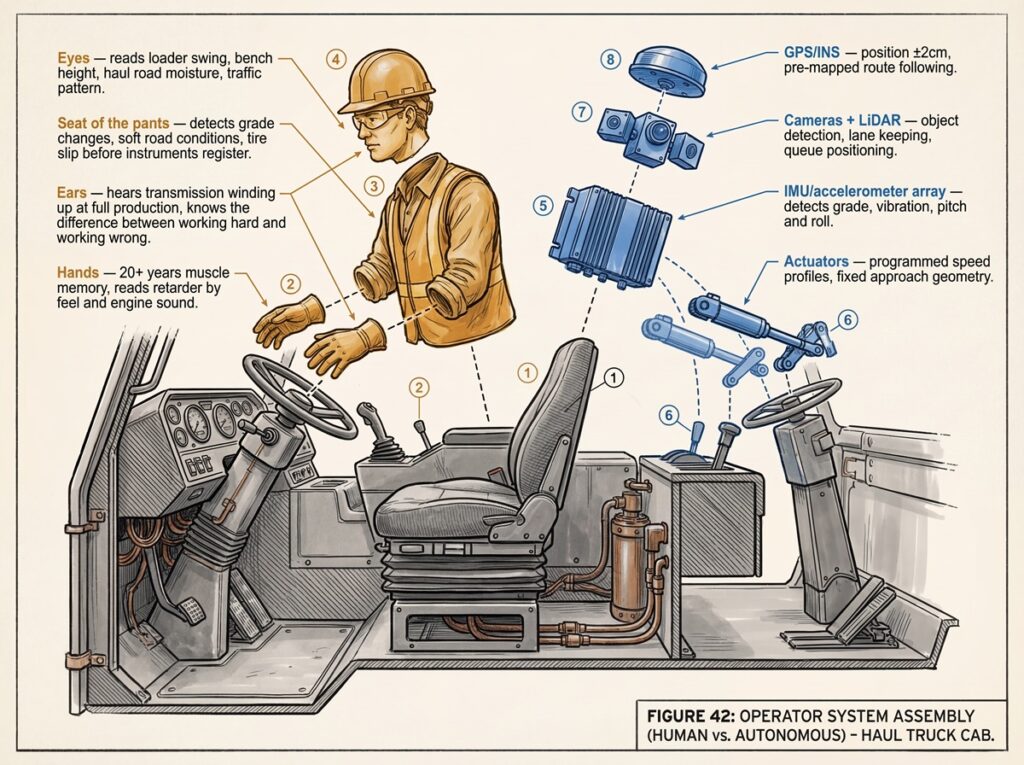
An experienced operator does not just drive a truck from A to B. They read the haul road. They feel the grade change through the seat. They adjust speed and line based on conditions that shift by the hour, from moisture in the fill, or a soft spot near the dump edge to the way the loader operator is swinging today.
They manage their tyres, protect their transmission and position at the loading face in a way that sets up the next truck behind them. This is not a simple control problem; it’s an integrated, context-dependent skill set built over years.
This is the standard autonomy must meet. When I watch an autonomous truck operate, I ask myself: would the pit supervisor notice? Would an experienced operator sitting in the passenger seat wince at the line it chose, the speed it carried into a curve or the way it spotted at the shovel? If the answer is yes, then the system is not ready.
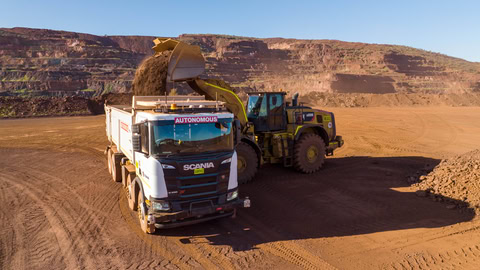
Even the most established autonomous haulage systems from Caterpillar and Komatsu, representing billions of dollars of development and millions of operating hours, struggle to pass this test consistently. Their trucks often drive conservatively to a fault, creeping through intersections, taking wide lines, leaving production on the table.
An experienced operator watching an autonomous haulage system (AHS) fleet can almost always tell the trucks are running without a human. That gap represents real tonnage and real dollars.
Building the right training set
I want to be clear: I believe a properly structured approach to machine learning can close this gap. The tools and computing capability exist. What’s often missing is depth in the training set.
A training set built by engineers who have never sat in a haul truck cab, who have never watched a skilled dozer operator feather a blade across a grade, who have never seen how an experienced excavator operator reads the muck, will produce a system that drives like a textbook rather than a professional.
The knowledge that separates a competent autonomous system from a convincing one lives in operational details that only experienced practitioners can articulate. It’s in the subtle speed adjustments a dozer operator makes when the material changes from shot rock to clay. It’s in the way a truck operator reads the bench height and adjusts their approach to the shovel.
This is domain knowledge that cannot be reverse-engineered from GPS traces and accelerometer data alone. It has to be deliberately captured and structured by people who understand what they are looking at.
Technology companies that want to pass the Turing test for autonomous equipment need to invest as heavily in domain expertise as they do in computing. They need mining engineers and veteran operators embedded in their development teams, not as consultants brought in for a two-week ride-along, but as permanent voices shaping the training data, the reward functions and the performance criteria.
The five centuries of knowledge since De Re Metallica are not an obstacle to automation, they are the foundation on which credible automation must be built. The companies that understand this will be the ones whose machines finally make the old hands in the pit shrug and say, “that’ll do.”
Continue the conversation… Dr Benjamin Miller is an autonomy advisor with decades of experience across global mining and construction operations. He is principal consultant at mule.bot (formerly Autonomous Correct), where he advises mining companies and technology developers on the deployment of autonomous mobile equipment and off-road autonomy systems. Miller is a graduate of the Colorado School of Mines and has worked on autonomy initiatives across multiple continents. Connect with Ben on Linkedin.